
The short version
Go to the Langhe in autumn, when the white truffle is out and the Barolo hills turn gold. Base at Il Boscareto in Serralunga or the greener Casa di Langa near Cerretto, book your wineries and truffle hunt before you land, and give it four nights. Alba’s truffle fair runs October 10 to December 6, 2026.
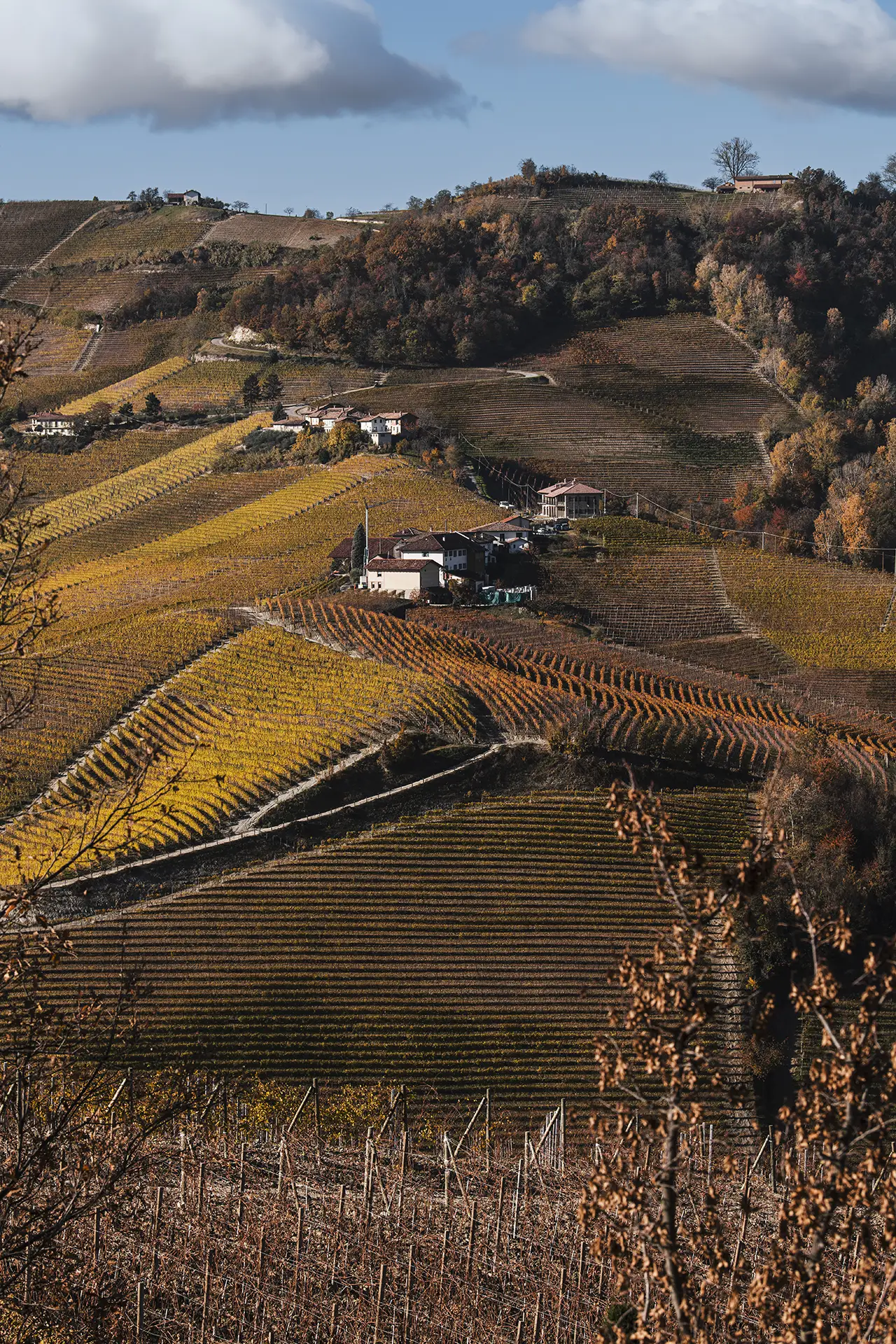
There is a stretch of about eight weeks every autumn when the Langhe is the best place to eat in Italy, and most people miss it. The vines go copper and gold, the fog that gives Nebbiolo its name settles into the valleys at dawn, and somewhere in the oak woods a man and his dog are digging up a knob of white truffle worth more per gram than the wine in your glass. This is the trip I send serious eaters and drinkers on, and I send them in the fall.
The Langhe sits in southern Piedmont, an hour or so below Turin, and it is small — you can drive across the heart of Barolo in twenty minutes. But it punches far above its size, because this is where Barolo and Barbaresco are made and where the Alba white truffle comes out of the ground. Two of the most collectible wines on earth and the most expensive ingredient in any kitchen, grown in the same handful of hills.
Here is how I’d do it: when to come, where to sleep, and how to taste Barolo without wasting a single one of your appointments.

When should you go to the Langhe?
Autumn, and specifically mid-October through early December. That is white-truffle season, when the fresh Alba tuber is shaved over everything and the region is at full tilt. It is also harvest and the tail of it, so the hills are at their most beautiful — amber and rust instead of summer green.
The anchor is the International Alba White Truffle Fair, which in 2026 runs from October 10 to December 6, mostly on weekends in Alba’s old market halls. It is worth an afternoon for the theater of it — the graded truffles under glass, the smell that hits you at the door — but I steer clients toward weekdays for everything else. Saturday in Alba in November is a scrum. Come Sunday night through Thursday and you get the same truffle on your pasta with a fraction of the crowd. If you can only travel in summer, the wine and the landscape still deliver; you just trade the truffle for longer, warmer evenings.
Where should you base yourself?
Pick one hotel and stay put — the distances are short and the pleasure here is slowness. I use three, and which one I book depends on the traveler.
Il Boscareto is my pick for the classic Barolo view. It sits high in Serralunga d’Alba, on the powerful eastern side of the appellation, surrounded by the Batasiolo family’s vines with the 14th-century Serralunga castle tower on the horizon. It runs 49 rooms and suites, a spa called La Sovrana with an indoor pool, and two kitchens — the ambitious La Rei Natura from chef Michelangelo Mammoliti and the easier, everyday Il Sunsi bistrot. There is even a helipad if you are arriving in a hurry. Ask for a room on the vineyard side, high up; the sunrise over the Serralunga slope is the reason to be here.

Casa di Langa is where I send the design-minded and the sustainability-minded. It opened in 2021 on a 42-hectare estate near Cerretto Langhe, a little higher and greener than the Barolo core, and it was built to be genuinely low-impact — geothermal and solar energy, no single-use plastic. Its 39 rooms all have private terraces over the hills, there is an outdoor infinity pool and the Lelose spa, and the kitchen, Faula, under chef Francesco Clerico, cooks modern Piedmontese from the estate’s own gardens. It is the quieter, more contemporary stay, and the one families and design lovers tend to prefer.
Relais San Maurizio is the romantic in the group — a former 1619 Cistercian monastery outside Santo Stefano Belbo, in the Alta Langa about forty minutes east of the Barolo villages. The 36 rooms sit in the old monks’ quarters under vaulted ceilings, there is a spa with salt caves carved below, and the restaurant, Guido, is a Piedmontese institution. Book this one for a couple who want stone walls, silence, and candlelight over proximity to the cellars.
How do you taste Barolo without wasting the trip?
Understand the geography first, because it decides what ends up in your glass. Barolo is made across 11 communes from a single grape, Nebbiolo, but five villages do most of the talking: La Morra and Barolo on the western side, Serralunga d’Alba and Monforte d’Alba on the east, and Castiglione Falletto in the middle. The west, on paler marl soils, gives the more perfumed, approachable Barolo; the east, on tougher clay and sandstone, gives the powerful, structured, age-forever style. Taste one of each and you understand the whole region in an afternoon.
The one rule that saves the trip: the good producers are by appointment only, and the great ones book up weeks ahead in autumn. Do not plan to knock on cellar doors — line up two visits a day, no more, with a long lunch between them, and let the hotel or your advisor make the introductions to the estates you really want. Don’t overlook Barbaresco either; it is the same Nebbiolo grown just north around the villages of Barbaresco, Neive and Treiso, a shade more elegant and often easier to drink young. Alba, the small city in the middle, is your hub for both, and the place to be for dinner.

And do the truffle hunt. It sounds like a set piece and it is, but a morning in the woods with a trifolau — a local truffle hunter — and his dog is the most fun you will have here, and it ends with a tasting. Then eat the thing properly: tajarin, the thin Piedmontese egg pasta, with butter and a snowfall of white truffle shaved at the table. That single plate is worth the flight.
What You Actually Want to Know
How do I get to the Langhe?
Fly into Turin, which is about 62 km and an easy 1 hour 15 minute drive from Alba, or into Milan, roughly two hours away, if the flights are better. There is a regional train from Turin to Alba, but the wine villages are spread across the hills — rent a car or arrange a driver, or you will spend the trip stuck in one town.
Is the Alba truffle fair worth planning around?
Yes, but as one element, not the whole trip. The 2026 fair runs October 10 to December 6, on weekends. Go once, on a weekday if you can, then spend the rest of your time in the villages and cellars where the truffle is really cooked and the crowds thin out.
Barolo or Barbaresco — what’s the difference?
Both are Nebbiolo from neighboring hills. Barolo, from the villages south of Alba, is bigger, more tannic and built to age. Barbaresco, just north, is generally a little softer and more perfumed, and often drinks well younger. Taste both; you don’t have to choose.
How many days do I need?
Four nights is the sweet spot. That gives you two full days of winery visits, a truffle hunt and long lunch, an afternoon in Alba, and a day to do nothing but sit on a terrace with a bottle and the view. Three works; five is bliss if the eating is the point.
Do I need to book wineries in advance?
Almost always, yes. The serious estates receive by appointment, and in truffle season the best slots go weeks ahead. Book before you arrive, cap it at two a day, and lean on your hotel or advisor for the introductions that get you in the door.
The Langhe rewards a trip that’s planned down to the appointments and then left loose enough to linger. If you want to go this autumn, tell me when you can travel and how you like to eat, and I’ll build the trip around the table.
Planning more of Italy, or building a trip around the table? Read our guides to the best luxury hotels in Tuscany, Emilia-Romagna’s food country, and the Champagne region.
Plan Your Next Journey
Work with a Noon Travel advisor for a trip that exceeds every expectation.
Get Started