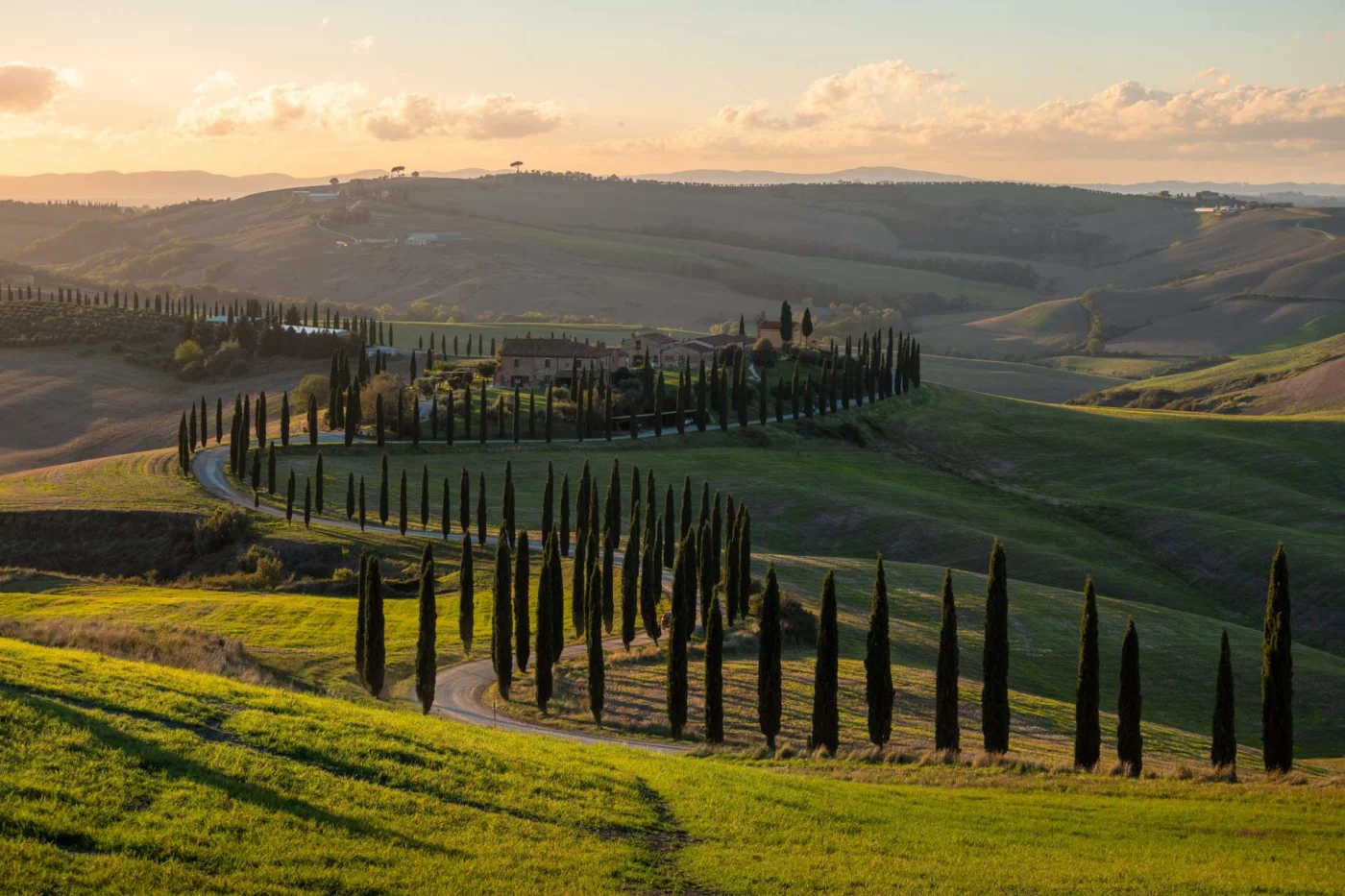

There is a version of Tuscany that belongs to everyone — the postcard hilltops, the cypress-lined roads, the Chianti you drink on a terrace while the sun dies over Siena. That version is real, and it is worth everything. But there is another version, harder to reach, that has nothing to do with crowd management or booking windows. It has to do with which room you're in, which estate you're sleeping on, and whether someone who actually knows the region helped you get there. This is a guide to that version.
Tuscany is not one destination. It is a loose confederation of landscapes — the vineyard-carved hills of the Val d'Orcia, the cool pine forests of the Maremma coast, the urban density of Florence, the quiet medieval towns strung across the Sienese countryside like forgotten punctuation. Getting it right means knowing which part of it you actually want, and then choosing accordingly.
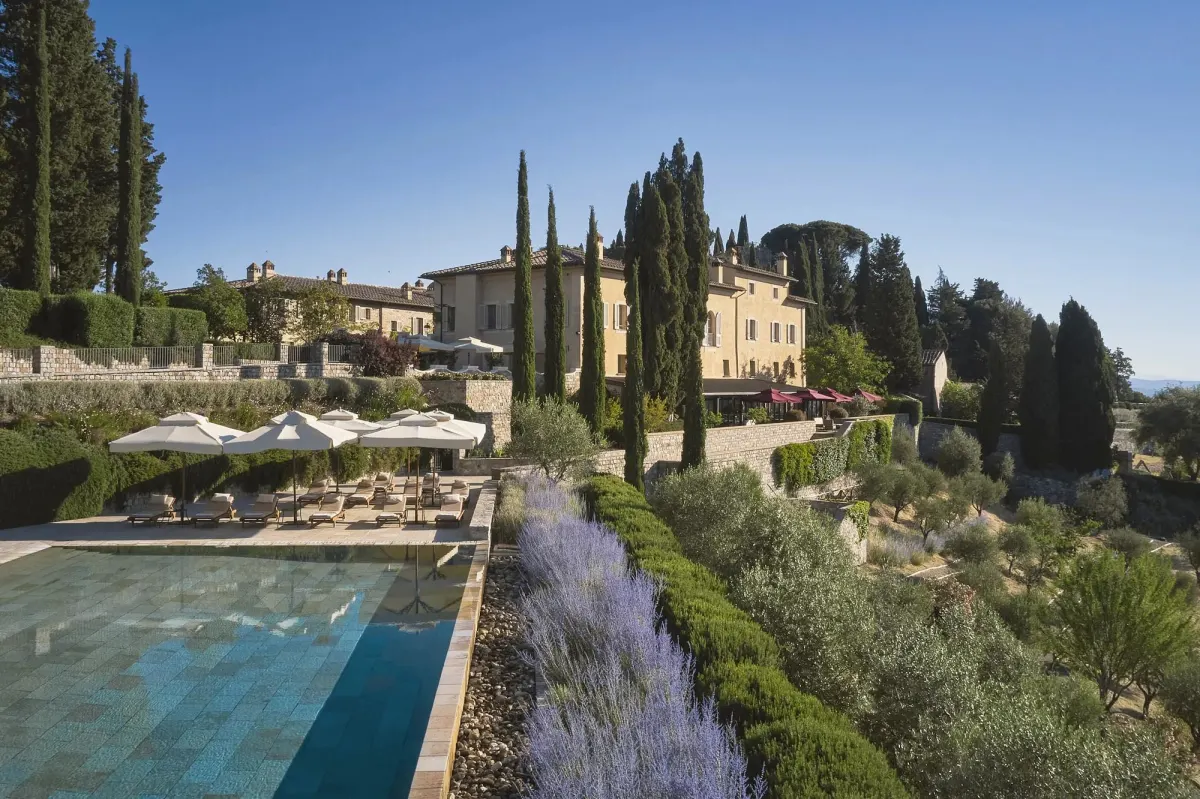
Rosewood Castiglion del Bosco sits on 5,000 acres of private estate in Montalcino — the same land that produces some of the finest Brunello di Montalcino in Italy. The resort itself is a restored medieval borgo: 42 suites and 11 private villas spread across 17th- and 18th-century farmhouses, each with terraces, gardens, and access to a private 18-hole golf course. The Michelin-starred Ristorante Campo del Drago is the centrepiece of the dining program, focused on the estate's own produce and the wines of its cantina. Forbes Travel Guide awarded Castiglion del Bosco Five Stars in its 2025 Star Awards — the top rating in the guide. Villas come with a Land Rover Defender or equivalent 4x4 for use during the stay. There is a private helipad on the estate. This is not a hotel that asks you to make do.
In Florence, Four Seasons Hotel Firenze occupies a 15th-century palazzo and a former convent on Borgo Pinti, set within an 11-acre private garden that remains one of the most extraordinary green spaces in the city. It is the only Forbes Travel Guide Five-Star property in Florence proper — a designation it has held for ten consecutive years. The 117 rooms and suites are distributed across two historic buildings connected by the garden, and the property operates with a formality that feels earned rather than performed.
For those who want a hotel that has nothing to prove, Hotel Il Pellicano in Porto Ercole remains the standard by which Maremma coast properties are measured. Originally built as a private home by an American couple in the 1960s and converted into a hotel shortly after, Il Pellicano has the quality of a place that was designed to be enjoyed rather than photographed — though it photographs exceptionally well. The 77 rooms and cottages are distributed across the clifftop above the Tyrrhenian Sea. The Forbes Travel Guide–listed restaurant, headed by group executive chef Michelino Gioia, specialises in locally sourced seafood. The pool hangs over the water. In season, a table here requires advance planning.

Borgo Pignano, outside Volterra, occupies an organic agricultural estate of around 750 acres — working farm, olive groves, vineyard, and kitchen garden all feeding directly into a kitchen that takes the concept of locality seriously. The property has 22 suites across the estate's restored farmhouses, an infinity pool that looks out over an unbroken stretch of Tuscan hill country, and a spa designed around the estate's own botanical production. It is not Forbes-rated, but it represents a category of Tuscan property that has become increasingly significant: the working estate where the agricultural rhythm of the place is the experience itself, rather than a backdrop to it.
Belmond Castello di Casole, near Siena, is a 10th-century castle converted into a 39-room hotel on a 4,200-acre estate that includes working vineyards and olive groves. The property's position — elevated, commanding views in every direction, with the estate rolling out below it — is among the strongest of any hotel in Tuscany. The conversion preserved the castello's historic architecture while building a spa, several pools, and a restaurant program tied to the estate's production. Belmond's Villa San Michele, for contrast, sits in the hills above Florence in a 15th-century monastery attributed in part to Michelangelo, with 45 rooms and suites and a loggia that looks across the rooftops of the city below.
The honest answer to "which part of Tuscany" depends on what you're actually after. If the answer is a working wine estate with Five-Star service and a private golf course, Castiglion del Bosco. If it's a city base with access to the Uffizi and a private garden that shuts the city out entirely, Four Seasons Firenze. If it's a coastal property where lunch feels like an event and the pool is positioned precisely so, Il Pellicano. If it's something slower, rooted in the agricultural life of the land, Borgo Pignano or one of the Belmond estates.
These are not interchangeable destinations with similar amenities at different price points. Each one has a character that takes time to understand and rewards staying longer than you planned. The week you thought you'd divide between Florence and Siena often becomes a week at one place, realising on day three that you haven't needed to leave. That is the particular quality of Tuscany done correctly — not the itinerary you planned, but the one the land makes for you.
Every itinerary Noon builds starts with one conversation — not a template. Tell us where you want to go.
Further reading
- Provence vs. Tuscany: Which Summer Should You Book?
- Belmond’s Villa San Michele Is Back — And Florence’s Best Hotel View Just Got Better
- Rosewood Rome Is Opening in 2026 — Here's What to Know
- Danieli, A Four Seasons Hotel, Venice: Reservations Open for August 26, 2026
- Villa Timeo, Taormina Opens May 2026 — Belmond’s 21-Key Power Move
Plan Your Next Journey
Work with a Noon Travel advisor for a trip that exceeds every expectation.
Get Started