
The short version
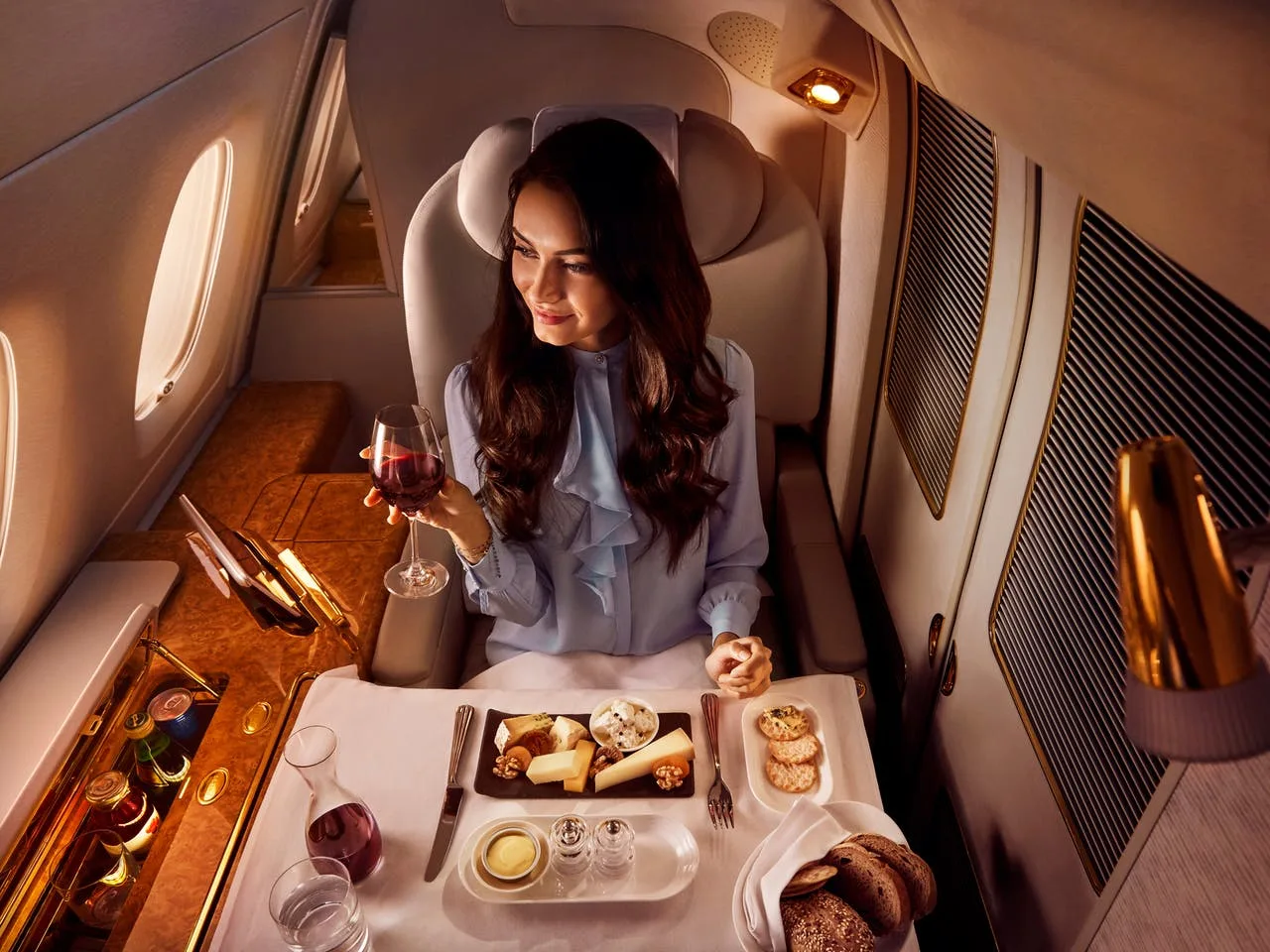
First class usually costs double business class on the same route, and on most airlines the extra buys a slightly bigger seat. It is worth paying when the product is genuinely separate — Emirates, Singapore, Etihad, Lufthansa, Air France — when you are flying as a couple, or when you are paying with miles instead of money.
Ask ten well-travelled people whether first class is worth it and you will get ten confident answers, all of them wrong in the same way. They are answering about a cabin. The real answer depends on the airline, the aircraft, the route, who you are flying with, and whether the money leaving your account is dollars or miles.
The gap has also narrowed. Business class in 2026 is a private suite with a door on almost every airline worth flying, which was a first-class feature ten years ago. Meanwhile most Western carriers quietly deleted first class altogether — American retired its international Flagship First years ago, and Delta and United never replaced theirs. Business class is now simply what premium long-haul travel is.
Which leaves a smaller, stranger question: when the two cabins sit on the same plane, and the front one costs twice as much, what is that money buying? Sometimes almost nothing. Sometimes something you will still be describing at dinner parties a decade later. Here is how to tell the difference before you book.
What is the real price gap between business and first?
On most long-haul routes, first class runs from about 60% more than business at the low end to well over double at the high end. On the flagship products — Emirates A380 out of Dubai, Singapore Suites, Etihad on the A380 — a peak-season one-way can land at three to four times the business fare.
That gap is not fixed. It moves with the calendar, the route, and how close to departure you book. The same Emirates suite can price wildly differently depending on whether you are booking eight months out or eight days out, because premium cabins are dynamically priced and the front of the plane fills late with people who are not paying their own way. If you are flexible on dates, the spread between a good day and a bad day in first is often larger than the entire business-class fare.
The useful way to frame it: do not ask whether first class is worth $12,000. Ask whether the upgrade from business is worth $5,000, because that is the actual decision.
Which airlines still fly a real first class?
A shrinking list, and it matters enormously which one you are on. The products still worth the premium in 2026: Emirates (A380 and the Boeing 777 "Game Changer" suites), Singapore Airlines (Suites, A380 only), Etihad (A380), Lufthansa (the new Allegris first class on the A350), Air France (La Première), plus Swiss, British Airways, ANA, Japan Airlines, Cathay Pacific, Korean Air and Qantas on selected aircraft.

Emirates is the one most people mean when they say first class. The A380 suite has privacy doors, an onboard shower spa, and a lounge bar at the back of the upper deck. The 777 suite is fully enclosed floor-to-ceiling, with virtual windows for the centre seats and interiors deliberately modelled on a Mercedes-Benz S-Class. They are different experiences, and the aircraft your route is flown with decides which one you get — check the equipment, not the airline.
Note who is missing: Qatar Airways. It does not fly a first class at all today, and it is still the airline most seasoned travellers would pick, because Qsuite — a business-class suite with a door, and quad configurations that turn into a private room for four — is better than several airlines' first. Qatar has now unveiled a next-generation Qsuite and confirmed a new first class for the Boeing 777-9, but those aircraft are not expected to arrive before 2027. That tells you everything about how far business class has come.
What does business class give you now that first used to?
The door. That was the dividing line, and it is gone. A modern business-class suite gives you direct aisle access, a closing door, a fully flat bed, a large screen, and dining on demand. On Qatar, ANA, Japan Airlines, Cathay and Delta One, that suite is genuinely excellent — enough that on many routes, spending the difference on the hotel is the better trade.
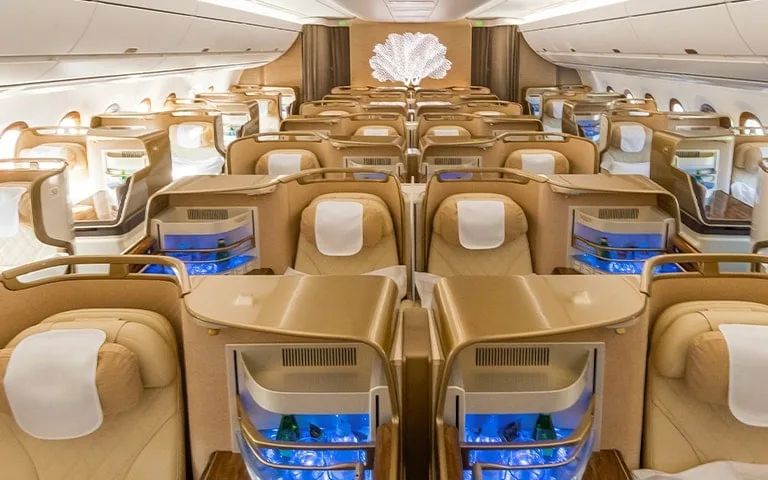
What business class still does not give you is space and silence. A first-class cabin holds four to fourteen people instead of forty. The ratio of crew to passengers changes, the noise changes, the boarding changes, and the ground experience changes — which, on the best airlines, is where the money actually goes. If you have read our guide to the next-generation Delta One suite, you already know how much of the premium-cabin arms race is now happening in business.
When is first class worth the money?
Four situations, and only four.
When the product is a separate experience, not a bigger seat. Emirates on the A380 is the clearest example: you can shower at 40,000 feet over the Caspian, then walk to the bar. Etihad's Residence on the A380 goes further — a three-room suite for up to two guests, with a double bedroom, a living room and an ensuite shower, sold as a seat-selection option on top of a First ticket and flown on the A380 routes between Abu Dhabi, London, New York and Paris. Nothing in business class is remotely comparable, because it is not the same category of thing.

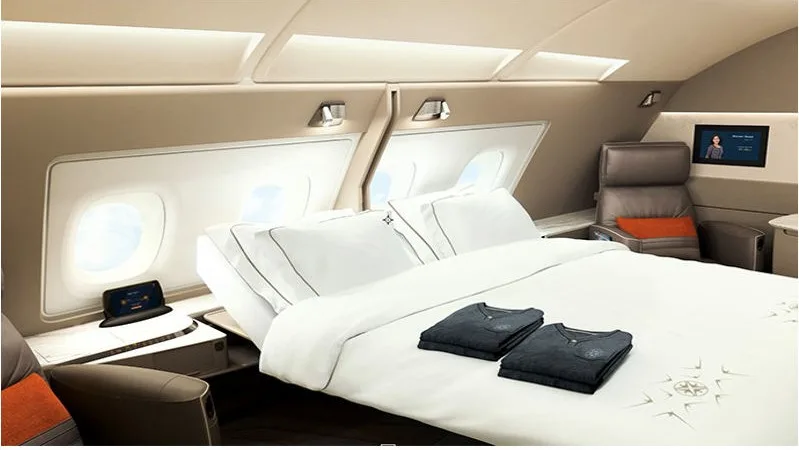
When you are flying as a couple. This is the most underused argument in premium travel. Singapore's A380 Suites can be combined into a double bed if you book adjoining Suites 1A and 2A, or 1F and 2F — the divider between the two rooms comes down and you get an actual double bed, not two beds beside each other. And Lufthansa has just made the maths work: for travel from 1 July 2026, any first-class passenger can select the Allegris Suite Plus double suite at no extra charge, and a couple booking it together gets 50% off the second first-class fare. That is the cheapest route into a real first-class cabin that exists right now, and it is bookable by phone rather than online — which is precisely the sort of thing an advisor is for.
When the ground experience is the product. Lufthansa's First Class Terminal in Frankfurt is a separate building with its own immigration desk, from which you are driven across the apron to the aircraft steps in a chauffeured car. Air France's La Première — four suites at the front of the 777-300ER — comes with a private lounge at Charles de Gaulle and a car to the aircraft door. On both, the flight is arguably the least interesting part of the ticket. If you have ever missed a connection because of a passport queue, you understand exactly what that is worth.
When you are paying with miles. The cash gap between business and first can be double. The mileage gap is frequently far less than that, which is why first class is the single best use of a large points balance. It is also the hardest to find: airlines release first-class award space sparingly, often at exactly 355 days out or within the final two weeks. Patience and flexibility are the entire strategy.
How do you get into first without paying full fare?
Three routes that work. Redeem miles, and book the moment award space opens or wait for the late release — Lufthansa, famously, only opens most first-class award seats to partners within about 14 days of departure. Bid for an upgrade, where the airline sells the front cabin cheaply rather than flying it empty; Etihad, Emirates, Cathay and others run bid programmes and the winning numbers are often far below the fare difference. Or book two people into a cabin designed for two, which is where the Lufthansa 50% second fare and Singapore's double suite quietly beat every other strategy.
What does not work: assuming status will do it for you. Complimentary upgrades from business to first on long-haul are close to extinct outside of the most senior tiers. If getting moved forward matters to you, our guide on how to get an upgrade — and when it is worth asking applies in the air as much as it does on the ground.
What You Actually Want to Know
Is first class worth it on a daytime flight?
Rarely. Almost everything you are paying for in first class — the bed, the sleep, the quiet — matters most overnight. On a daytime sector, a business-class suite with a door does the same job for half the price. Spend the difference on the night flight home.
Which airline has the best first class right now?
For the full theatre of it — shower, bar, suite — Emirates on the A380. For the best seat and service combined, Singapore Suites. For couples, Lufthansa's Allegris double suite, on price. Etihad's Residence is in its own category and is priced accordingly.
Do any US airlines fly international first class?
No. American, Delta and United all sell business class as their top long-haul cabin, and Delta One is the strongest of the three. Anyone advertising "first class" on a US transatlantic flight is describing business.
Is business class enough for a 14-hour flight?
On a good airline, yes. Qatar's Qsuite, ANA, Japan Airlines and Cathay all give you a door, a flat bed and a proper night's sleep. The exhaustion on ultra-long-haul comes from the schedule and the connection, not from the seat — which is why routing matters more than cabin on trips of that length.
Is a private jet cheaper than four first-class tickets?
Almost never on long-haul, though the gap narrows fast on short regional hops with a full party. We break the numbers down in our guide to private jet travel.
Every itinerary Noon builds starts with one conversation, not a template — including the unglamorous parts, like which aircraft is flying your route on the day you want to travel, and whether the seat at the front is the one worth having. Start yours.
Plan Your Next Journey
Work with a Noon Travel advisor for a trip that exceeds every expectation.
Get Started