
The short version
Vienna is where modern design was born in an argument. Start at the Secession’s golden dome and Klimt’s Beethoven Frieze, walk Otto Wagner’s tiled Majolica House, drink where Adolf Loos invented the modern bar, and find Klimt’s The Kiss at the Belvedere. Base yourself at the Park Hyatt, the Rosewood, or the Sacher.
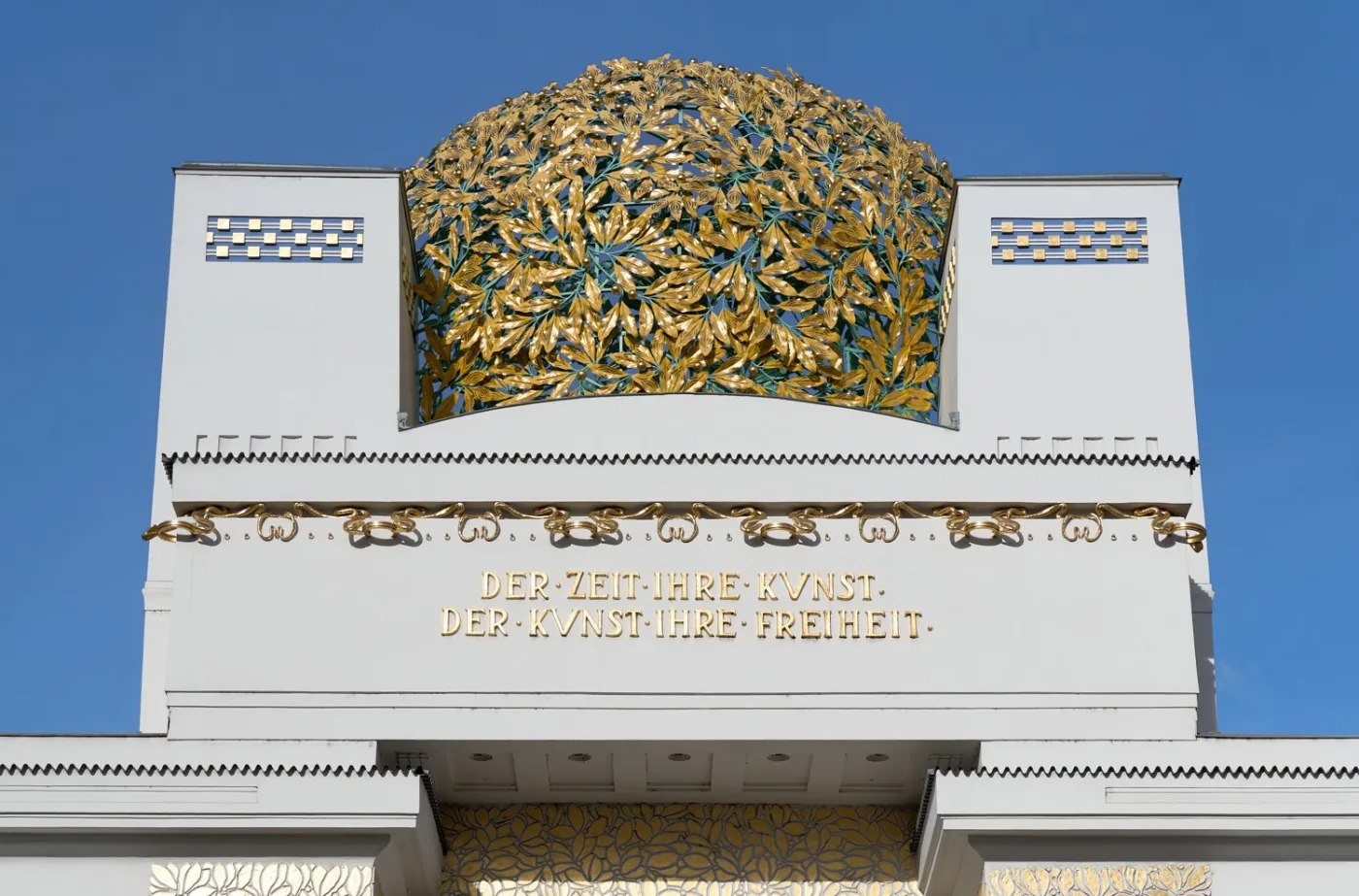
In 1897, a group of Viennese artists led by Gustav Klimt walked out. They were done with the gilded historicism of the Ringstrasse, done with the establishment salon, done with painting the past. They called themselves the Secession, carved their motto over a door — Der Zeit ihre Kunst, der Kunst ihre Freiheit, to every age its art, to art its freedom — and built a white temple with a dome of golden laurel leaves that the locals promptly nicknamed the golden cabbage. It is still there, still shocking against the Baroque, and it is the best place to start understanding this city.
Vienna sells itself on emperors and waltzes, and most visitors dutifully do the Habsburg circuit and leave. That is the wrong Vienna. The one worth flying for is the one that got invented here between roughly 1897 and 1914 — the Secession, the Wiener Werkstätte, Otto Wagner’s buildings, Adolf Loos’s bars, Klimt’s gold. This is the birthplace of modern design, and unlike a museum, most of it is still standing on the street where it was built.
If you have already done our design deep-dives on Tokyo and Copenhagen, think of Vienna as the origin story both of them are quietly answering to. Here is how to read the city like a designer, and where to sleep while you do it.
Where did modern design break away in Vienna?
At the Secession building on Friedrichstrasse, finished in 1898 to a design by Joseph Maria Olbrich. It was purpose-built as an exhibition house for artists who had rejected the academy, and everything about it — the cubic white massing, the sparse ornament, that perforated dome of 3,000 gilded laurel leaves — announced a clean break with the wedding-cake architecture around it.
Go down to the basement. Klimt’s Beethoven Frieze lives there: 34 metres of painted wall, made for a single 1902 exhibition honouring Beethoven and meant to be destroyed afterward. It survived by accident and has been on permanent display in the building since 1986. Standing in that low room with the frieze wrapping three walls — the floating figures, the gold, the hostile giant — is the closest thing Vienna has to a religious experience for design people. It is also usually far quieter than the Klimt everyone queues for across town.
Which Otto Wagner buildings are worth the walk?
Otto Wagner is the reason Vienna looks modern before modern was a word. He was the establishment architect who turned radical in his fifties, and he left the city a handful of buildings that any design traveller should see in person.
Two of them sit side by side on the Linke Wienzeile, above the Naschmarkt. The Majolica House at number 40 is the showpiece: its entire facade is sheathed in glazed ceramic tiles in a pink-and-green floral pattern that runs up the building like climbing roses — weatherproof, washable, and completely unlike anything built before it. Then walk to the first district for the Postsparkasse, Wagner’s postal savings bank of 1904–06, where he clad the exterior in thin marble panels fixed with exposed aluminium bolts and built a glass-roofed banking hall that still looks like the future. His Karlsplatz metro pavilions, green iron and gold sunflowers, are a two-minute walk from the Secession.

Where do you drink like it’s 1908?
At the Loos American Bar, a two-minute walk from St. Stephen’s. Adolf Loos designed it in 1908, and it is tiny — the main room is barely four and a half by six metres — but he lined it in mahogany, onyx and marble and papered the upper walls in mirrors, so the box seems to dissolve into infinity. It seats maybe two dozen. Go early or expect to wait; this is one small room, not a scene.
Loos also designed the Café Museum in 1899, so stripped of the usual plush that Vienna nicknamed it Café Nihilismus — and then filled it with Klimt, Schiele and Wagner anyway. For the full imperial-coffeehouse spectacle, go to Café Central in the Palais Ferstel, under vaulted ceilings that once sheltered Trotsky and half of literary Vienna. Order a mélange, take a newspaper on a wooden holder, and stay an hour — lingering is the entire point. If bar design is your reason to travel, it pairs well with our guide to the best hotel bars in New York and a night out in Lisbon after dark.

Where is Klimt’s The Kiss?
At the Upper Belvedere, and yes, it is worth it. The Kiss — painted 1908, a 180-centimetre gold square of two lovers dissolving into pattern — hangs in a Baroque palace that also holds 24 Klimt paintings, the largest collection anywhere, plus major Schiele and Kokoschka. Buy a timed ticket online and go at opening; by midday the room around The Kiss is a wall of phones.
Two more stops finish the picture. The Leopold Museum in the MuseumsQuartier owns the world’s most important collection of Egon Schiele — more than 40 paintings — and is the single best place to understand how quickly Vienna’s gold curdled into something rawer. And the MAK, the Museum of Applied Arts, holds the Wiener Werkstätte archive and the largest museum collection of the workshop’s objects on earth: the chairs, glassware, jewellery and graphics where Josef Hoffmann and Koloman Moser turned Secession ideas into things you could own. It is the design traveller’s museum in a city full of them.

Which hotel fits a design pilgrimage?
Three, depending on your temperament. The Park Hyatt Vienna is the design obsessive’s pick: it occupies a former bank headquarters on Am Hof, its swimming pool sits inside the old steel vault, and the artwork in every room is based on a Wiener Werkstätte brooch. The bar and brasserie fill the original cashier’s hall. It carries a Forbes Travel Guide Recommended rating and it is the most on-theme place to sleep in the city.
For something newer, the Rosewood Vienna opened in 2022 in a restored nineteenth-century building on Petersplatz, a three-minute walk from St. Stephen’s. Its 100 rooms and suites read as quietly contemporary rather than imperial, the Asaya spa is tucked at the top, and the Neue Hoheit rooftop bar is the reservation to make for sunset. It is a Forbes Travel Guide Four-Star hotel — ask for a room on the courtyard side if you want silence. And if you want the old Vienna undiluted, the Hotel Sacher faces the State Opera and has since 1876; its Sachertorte, invented by Franz Sacher back in 1832, is fifty years older than the hotel itself.
What You Actually Want to Know
How many days do you need? Three is the honest minimum for the design circuit — one for the Secession, Wagner’s Wienzeile and Karlsplatz; one for the Belvedere, Leopold and MAK; one for the coffeehouses, the Looshaus on Michaelerplatz and simply walking. Add a fourth if you want a day trip or a slower pace.
When is the best time to go? May or September. The weather is mild, the light is long, and you sidestep both the August heat, when many Viennese leave, and the Christmas-market crush. Spring also lines up with the museums’ strongest temporary shows.
Can you see the Beethoven Frieze year-round? Yes. It is on permanent display in the Secession building and is open to visitors alongside the changing contemporary exhibitions upstairs. It is rarely as crowded as the Belvedere.
Is Klimt’s The Kiss really in Vienna? Yes — at the Upper Belvedere, where it has hung for over a century. It does not travel. If someone offers you The Kiss anywhere else, it is a reproduction.
Vienna rewards travellers who know exactly what they are looking at — which door Loos built, which frieze Klimt nearly lost, which pool used to be a bank vault. That is the difference between seeing the city and reading it. Every Noon itinerary starts with one conversation, not a template. Tell us where you want to go.
Plan Your Next Journey
Work with a Noon Travel advisor for a trip that exceeds every expectation.
Get Started