The short version
A crewed Mediterranean charter is quoted as a weekly base fee, then add roughly 25–40% APA for fuel, food and berths, plus VAT (20% France, 22% Italy, 13% Greece and Croatia, 0% Montenegro) and a 10–15% crew tip. Budget the base fee plus about half again. The broker costs you nothing.
Every July, the same conversation happens in our inbox. Someone has seen a boat on a broker's website, noted the weekly rate, done the division by eight guests, and decided it is more or less the price of a good villa week. Then the contract arrives and the number has grown by half.
Nothing has gone wrong. That is simply how chartering works, and the gap between the advertised rate and the wire transfer is the single most misunderstood thing in yachting. The second most misunderstood: the person who explains it to you is free.
Here is the whole structure, in the order you will meet it.
What does a Mediterranean yacht charter cost?
Start with the base fee. It is quoted per week — seven days, Saturday to Saturday, and in high season the week is effectively non-negotiable. The fee buys the yacht, the crew, their wages and food, and marine insurance. Nothing else.
The range is enormous, and it is worth knowing where the rungs sit. A crewed catamaran or small sailing yacht starts around $10,000 a week. Serious motor yachts begin around $100,000. Maltese Falcon, the 88-metre Perini Navi and still the most recognisable sailing yacht on the water, lists from about €490,000 a week in summer. Kismet, the 122-metre Lürssen delivered in 2024, sits at roughly €3 million a week. There is no ceiling; there is only the next boat.

What the base fee does not include
Almost everything you will consume. Most Mediterranean charters run on a MYBA agreement — Western Mediterranean Terms, known in the trade as “plus expenses.” Fuel, food, wine, berths in Porto Cervo and Capri, port taxes, water toys, tenders burning diesel to take you to lunch: all of it is billed on top, at cost, with no markup.
Those costs are funded by the Advance Provisioning Allowance. You wire it before you board — typically 25–40% of the base fee, weighted toward the top of that range for large, thirsty motor yachts and itineraries with a lot of night marina berths. The captain holds it, spends it, keeps a running account you can ask to see at any point in the week, and hands back what is left in cash on the last morning. If you drink through it, you top it up mid-charter.
Then two more lines. VAT is charged on the base fee and depends on where you embark: 20% in France, 22% in Italy, 21% in Spain, 13% in Croatia, 13% in Greece for charters running longer than 48 hours, and nothing at all in Montenegro. That single fact quietly redraws a lot of itineraries. And crew gratuity — MYBA's own guidance is 5–15% of the base fee, and 10–15% is what actually changes hands. It goes to the captain, in one envelope, for the whole crew.
Run the arithmetic on a €150,000 boat out of Sardinia: roughly €45,000 APA, €33,000 Italian VAT, and €18,000 in tips. Call it €246,000. Half again, near enough.
Do you need a broker?
Yes, and this is the part almost nobody knows: the broker does not cost you a euro. Their commission is paid out of the owner's side of the charter fee, which means the rate is identical whether you book through a broker, through the yacht's central agent, or by emailing the owner's office yourself. Going direct does not save you money. It simply means the person negotiating the contract works for the other side.
Understand the two roles. The central agent represents the yacht and the owner — they manage the boat's calendar, its crew, its marketing. The retail broker represents you: shortlisting boats, checking whether the crew that got the glowing reviews is still aboard, negotiating the delivery fee, reading the contract, and being the person the captain calls when something breaks on a Tuesday. The names worth knowing are Burgess, Edmiston, Fraser, Camper & Nicholsons, Northrop & Johnson and Y.CO, and any advisor worth their fee already has a line into all of them.
Ask your broker for an APA estimate before you sign, not after. A good one will build it from your actual preferences — how many marina nights, how much cruising, what you drink — and get within a few thousand euros of the final statement.
Which route should you take?
Seven days at a comfortable cruising speed is a surprisingly small circle. Pick one cluster of islands and stay in it; the charters people regret are the ones that spent the week under way.
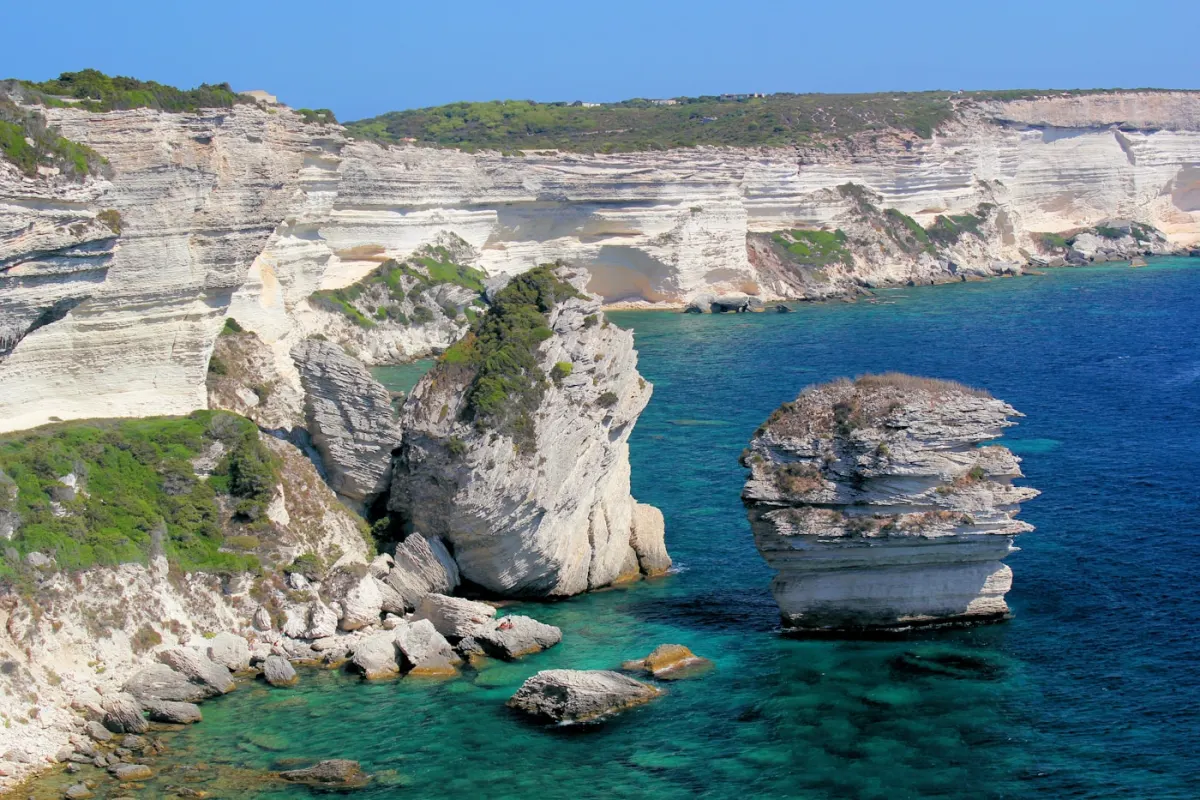
Sardinia and Corsica is the strongest week in the western Mediterranean and the one we book most. Out of Portisco or Porto Cervo, you can run the Maddalena archipelago, cross to the Lavezzi islands, put in under the chalk cliffs at Bonifacio, and be back on the Costa Smeralda by Saturday — four anchorages that would each justify the trip, inside about fifty nautical miles. It also pairs neatly with a few land nights; see our Sardinia guide for where to sleep before you board.
The Aeolians are the connoisseur's week. From Portorosa in Sicily: Vulcano, Lipari, Salina, Panarea, and then the whole point of the exercise — anchoring off Stromboli after dark and watching an active volcano throw sparks into the sea while the chef serves dinner on the aft deck. Nowhere else in Europe gives you that.

The French Riviera and Ligurian coast — Nice, Villefranche, Cap Ferrat, Monaco, Portofino — is the shortest hop-per-day route and the one to choose if half the party wants dinner ashore every night. It is also the most expensive water in the world to tie up in, and the week to avoid unless you are there for the Grand Prix, when the harbour becomes the grandstand and the rates reflect it.
The Balearics — Mallorca, Menorca, Ibiza, Formentera — is the beach-club week, and unapologetically so. Anchor off Ses Salines, tender in for lunch, sleep at anchor. Our guide to Europe's best beach clubs is essentially the itinerary.
Greece and Montenegro are the value plays, and not for the reason you think. Greek VAT at 13% and Montenegro's zero rate mean the tax line on a €200,000 boat swings by more than €40,000 depending on where you start the week. Embarkation port is a financial decision, not just a logistical one.

When to book, and when to go
July and August are high season, and the best boats for those weeks are gone by winter — the good ones are contracted six to twelve months out, and the very good ones are rebooked by last year's charterer before they disembark. If you are reading this in July hoping for August, you are shopping the leftovers, and you should say yes quickly to a boat with a great chef rather than hold out for a bigger hull.
The better answer is to move the week. Late May, June, and the whole of September deliver the same water temperature and clearer anchorages at meaningfully lower base rates, because rate cards drop outside the peak. September in the Aeolians or the Costa Smeralda is the best week in the Mediterranean calendar and it is not close.
Two contract details worth knowing before you sign. Delivery and redelivery fees apply if the yacht has to reposition to meet you — charged at cost, and negotiable, which is where a broker earns their keep. And cancellation and curtailment insurance runs around 2.5% of the charter fee. On a six-figure booking with children, elderly parents, or a hurricane-adjacent schedule, take it.
Yacht or villa?
Be honest about the trade. A yacht buys you movement, water access, and a crew whose entire job is your week — a chef who learns by Tuesday how you take your eggs, a deckhand who has the tender running before you have finished asking. A villa buys you space, a fixed address, and a bill that does not float.
The rule we use: if your party wants a different bay every morning and does not mind cabins smaller than they look in the brochure, charter. If they want to unpack once, spread out, and walk into town for dinner, take the house — and read how to actually book a private villa in the South of France first. The mistake is chartering a boat and then never leaving the marina, which is a very expensive hotel room with a small bathroom.
What You Actually Want to Know
How much does a Mediterranean yacht charter cost per week?
Crewed sailing yachts and catamarans start around $10,000 a week; motor superyachts begin near $100,000 and run into the millions for the largest boats. Whatever the base fee, plan on the all-in cost landing about 50% higher once APA, VAT and gratuity are added.
What is the APA and do I get it back?
The Advance Provisioning Allowance is a prepaid expense fund, typically 25–40% of the base fee, held by the captain to pay for fuel, provisions, berths and port fees at cost. You receive an itemised statement and any unspent balance is returned to you at the end of the charter.
Is it cheaper to book directly with the yacht's owner?
No. Broker commission is paid from the owner's side of the fee, so the price is the same whether you use a broker or not. Booking direct only removes the person who represents your interests in the contract.
What is the best month for a Mediterranean charter?
September. The sea is at its warmest, the August fleet has gone home, the anchorages open up, and base rates fall outside peak season. Late May and June are the next best windows.
How far in advance should I book?
Six to twelve months for July and August; the strongest boats and crews are committed well before the season starts. Shoulder weeks in May, June and September can often be secured two to four months out.
Noon's advisors have chartered these boats, know which captains are worth the week and which chefs are worth the tip, and read the contract before you do. Tell us where you want to wake up.
Further reading
- Private Jet Travel 101: What to Know Before You Book
- Sailing Indonesia on Rascal: Komodo and Beyond
- Sailing the Odyssey: Inside the $2.6M Voyage
- A Private Island on the Côte d'Azur Just Got a Wellness Programme Worth Flying For
- Orient Express Palazzo Donà Giovannelli Is Open in Venice
- How to Plan a Luxury Antarctica Expedition
- Delta One's Next-Generation Suite: Everything You Need to Know
Plan Your Next Journey
Work with a Noon Travel advisor for a trip that exceeds every expectation.
Get Started