The short version
Mendoza is South America’s great wine trip: Malbec, open-fire asado, and the Andes on the horizon. Base in Luján de Cuyo for the classics or the high-altitude Uco Valley for the icons — Zuccardi, Catena Zapata — and go in March or April for the harvest. Here is how to do it.
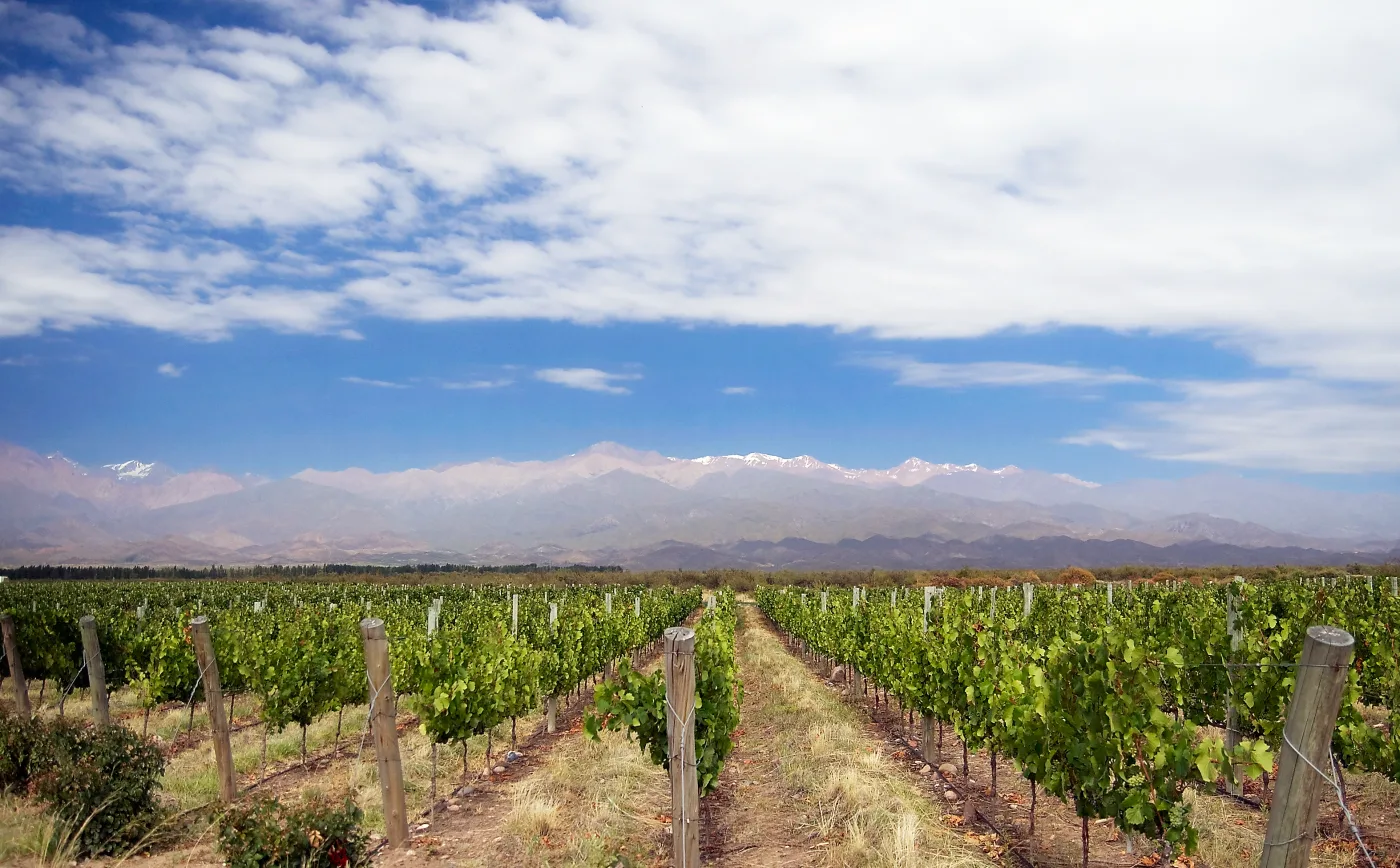
The drive out of Mendoza city tells you everything. Within twenty minutes the streets give way to roads lined with poplars, irrigation channels running silver alongside them, and then the vines — rank after rank of them, trained low and pointing at a wall of the Andes that never quite looks real. This is desert that was engineered into wine country more than a century ago, and the snow on those peaks is the reason any of it grows.
Mendoza pours most of Argentina’s wine and counts more than 900 wineries, and it is where Malbec — a grape France had all but given up on — found its second life. But the wine is only half the reason to come. The other half is the way it is served here: over an open fire, slowly, with the mountains going pink behind you. It is one of the few places where the landscape, the cooking, and the drinking all point in the same direction.
The question is never whether to go. It is where to base yourself, which doors are worth knocking on, and when to time the trip. Here is how we split it.
Luján de Cuyo or the Uco Valley: where should you base?
There are two centers of gravity, and the smart move is to give each a couple of nights rather than choosing. Luján de Cuyo is the classic zone — the first appellation Argentina protected, half an hour to forty-five minutes south of the airport, dense with old-vine Malbec and the wineries that built the region’s reputation. It is the easy, polished base: close to the city, close to the vineyards, short transfers between tastings.
The Uco Valley is the frontier. It sits roughly 90 to 120 kilometers south, a ninety-minute to two-hour drive, and climbs: vineyards here run from about 900 up to 1,500 meters and higher, the highest in Mendoza. Altitude means cool nights, slow ripening, and the tense, high-toned wines that have made the valley the region’s obsession over the last fifteen years. It is more remote and more dramatic, and it is where the icon wineries and the best new hotels have gone.

Which wineries are actually worth the appointment?
Tastings in Mendoza run by reservation, and a handful are worth building the day around. Zuccardi Valle de Uco, in Paraje Altamira, is the one to book first: it was named the World’s Best Vineyard three years running, from 2019 to 2021, and then retired into the award’s Hall of Fame. The winery is a piece of architecture in its own right — poured concrete and local stone set against bare mountains — and the lunch at Piedra Infinita is as much a reason to go as the wine.
Catena Zapata, back in Agrelo in Luján de Cuyo, is the other must: a Mayan-inspired pyramid rising out of the vines, from the family most responsible for proving high-altitude Malbec to the world. The standard visit walks you through the cellar and ends with a tasting and a blend-your-own session. Add Susana Balbo — the label of the first woman to earn a winemaking degree in Argentina — and you have three appointments that between them explain the whole region.

Where should you stay?
In Luján de Cuyo, Cavas Wine Lodge is the anchor — a Relais & Châteaux member on a 55-acre estate, its freestanding casitas each with a private plunge pool and a fireplace, plus a rooftop patio built for watching the sun drop behind the Andes. Rooms start around US$580 and villas run well past US$1,000 a night. For something smaller and design-led, Entre Cielos sits among the vines nearby with just 16 rooms and the only authentic Turkish hammam in Latin America — a genuinely different kind of wine-country spa.
In the Uco Valley, The Vines Resort & Spa is the headliner: 22 villas with wood-burning fireplaces, plunge pools, and private rooftop terraces facing the mountains, a member of Leading Hotels of the World, with rates from around US$593 a night. Its restaurant is the draw in its own right (more on that below). Nearby, Casa de Uco spreads 18 rooms, suites, and villas across a working vineyard estate around a mirror-still lake — quieter, more pared-back, and one of the most photogenic places to wake up in the valley.
What about the food?
Argentine cooking is fire cooking, and nowhere does it better than here. The name to know is Francis Mallmann, the country’s most famous chef, whose Siete Fuegos — “seven fires” — at The Vines is the reservation people plan whole trips around. Everything comes off open flame: whole cuts seared over embers, vegetables charred in the coals, the ritual stretched over hours. Even if you stay elsewhere, book a table.
Beyond Mallmann, nearly every serious winery now runs a long, wine-paired lunch, and the traditional asado — beef cooked slowly over wood, eaten in no hurry — is the through-line of the whole region. Pair the trip with a wine-country weekend elsewhere and the contrast is sharp: this is the anti-Napa, rawer and more remote, with the drama turned all the way up.

When should you go?
Harvest runs from late February through April, and it is the moment to aim for. March is the peak — the cellars smell of fermenting must, the vineyards are working flat out, and the first week brings the Fiesta Nacional de la Vendimia, one of the largest harvest festivals on earth, with parades and concerts across the city. Rooms sell out months ahead and rates climb, so book early. For the same light with fewer crowds, come in April, when the vines turn red and gold and the valley empties out. Mendoza sits in the Southern Hemisphere, so its autumn is North America’s spring — a useful thing when you are pairing it with the rest of the continent, from Patagonia to Peru.
What You Actually Want to Know
How do you get to Mendoza?
Fly into Buenos Aires, then connect on a domestic flight to Mendoza (MDZ), which takes about one hour and fifty minutes to two hours. From the airport it is a 30-to-45-minute drive to Luján de Cuyo and roughly 90 minutes to two hours south to the Uco Valley.
How many days do you need?
Four to five nights is the sweet spot: two in Luján de Cuyo for the classic wineries and easy access to the city, and two or three in the Uco Valley for the icon estates and the mountain views. Fewer than three nights and you spend most of the trip in a car.
Do you need a driver?
Yes. Wineries are spread across long rural roads, tastings involve wine, and the Uco Valley in particular has real distances between estates. A private driver-guide is the single upgrade that makes the trip work — and gets you into the appointments that are hard to book on your own.
Is the Uco Valley worth the extra drive?
For a serious wine traveler, yes. It is home to Zuccardi, the high-altitude vineyards driving the region’s reputation, and the best of the new hotels. If you only have time for one base, though, Luján de Cuyo is the more convenient choice.
When is the harvest festival?
The Fiesta Nacional de la Vendimia takes place in early March, with the main events over the first weekend. It is spectacular and it books out the city — plan accommodation and transfers months in advance.
Mendoza rewards the traveler who knows which rooms to request, which tastings to lock in, and what order to do it all in. Noon’s advisors book the region constantly and know which doors actually open. Tell us where you want to go.
Plan Your Next Journey
Work with a Noon Travel advisor for a trip that exceeds every expectation.
Get Started