The short version
Two nights of Georgian grandeur in Dublin at The Merrion, then a little over an hour’s drive to Ballyfin, the Regency country house in County Laois with 21 rooms and a 600-acre estate. Book the city first, the house second, and give Ballyfin at least two nights.
People ask me for “real Ireland,” and I always tell them the same thing: Ireland is two trips, and the good version does both. There’s the city — Georgian Dublin, the doorways, the pints, the National Gallery on a wet afternoon — and then there’s the country, where the whole point is that nothing happens on a schedule and you’re happier for it. Do one without the other and you’ve seen half the picture.
So here’s the trip I actually book. A night or two in Dublin to land, eat well, and feel the grandeur of the place. Then the drive southwest to Ballyfin, the most complete country-house stay in the country, where a 600-acre estate closes behind you and the phone signal politely gives up. It’s an easy line to draw on a map and a genuinely great week on the ground.
There’s even a thread running through it. The Dublin hotel I send people to was, three centuries ago, the birthplace of the Duke of Wellington. The country house at the other end was, before it became what it is now, the seat of Wellington’s own brother. You can drive the length of one family’s Ireland in an afternoon and stay beautifully at both ends.
Where should you stay in Dublin?
The Merrion. That’s the one I book, and I book it for the same reason my clients thank me for it later: it’s quiet. The Main House is four Georgian townhouses on Upper Merrion Street, built in the 1760s and facing Government Buildings, restored into a single 123-room hotel with 19 suites and one of the largest private art collections in the country hanging on its walls. No. 24 next door, now part of the hotel, is where Arthur Wellesley — the future Duke of Wellington — was born in 1769. You feel the history without anyone performing it at you.
What you’re paying for is discretion and a garden. Ask for a Main House room over the Garden Wing if you want the rococo plasterwork and the marble fireplaces; take the Garden Wing if you want the two private courtyards outside your window. Either way, book the Art Afternoon Tea in the Drawing Rooms at least once — it’s the room in the photo below, and it’s the most civilized hour you’ll spend in Dublin.

If you’d rather be where the city can see you, book The Shelbourne instead. It’s the grande dame on St. Stephen’s Green — open since 1824, 265 rooms, and the address where the committee chaired by Michael Collins drafted the Irish Free State constitution in 1922, in what’s now called the Constitution Room. The Shelbourne is a stage; The Merrion is a refuge. I send couples to the Merrion and first-timers who want the buzz to the Shelbourne, and nobody’s ever unhappy with either.
Why Ballyfin, and which room?
Because there’s nothing else quite like it in Ireland. Ballyfin is a Regency mansion at the foot of the Slieve Bloom Mountains in County Laois, built between 1821 and 1826 for Sir Charles Coote to designs by the great Irish architects Sir Richard and William Morrison. It replaced an earlier house owned by William Wellesley-Pole — the Duke of Wellington’s elder brother — which is the thread that ties it back to your Dublin hotel. The Cootes lived here for a hundred years; the Patrician Brothers ran a school on the grounds for much of the twentieth century; and after an eight-year restoration, the house reopened in 2011 as a 21-room hotel that still, somehow, feels like a private home you’ve been lucky enough to be invited into.
Every one of the 21 rooms is named for a figure from the house’s history, and they’re all different, so this matters. If you want the grand gesture, ask for one of the state rooms on the first floor overlooking the lake — marble bathrooms, four-posters, the full Regency treatment. If you’re a couple after something softer, the junior suites are the sweet spot. And if it’s a family or a group of friends, you can take the whole house exclusively, which is the single best way to experience Ballyfin and worth doing at least once in your life.
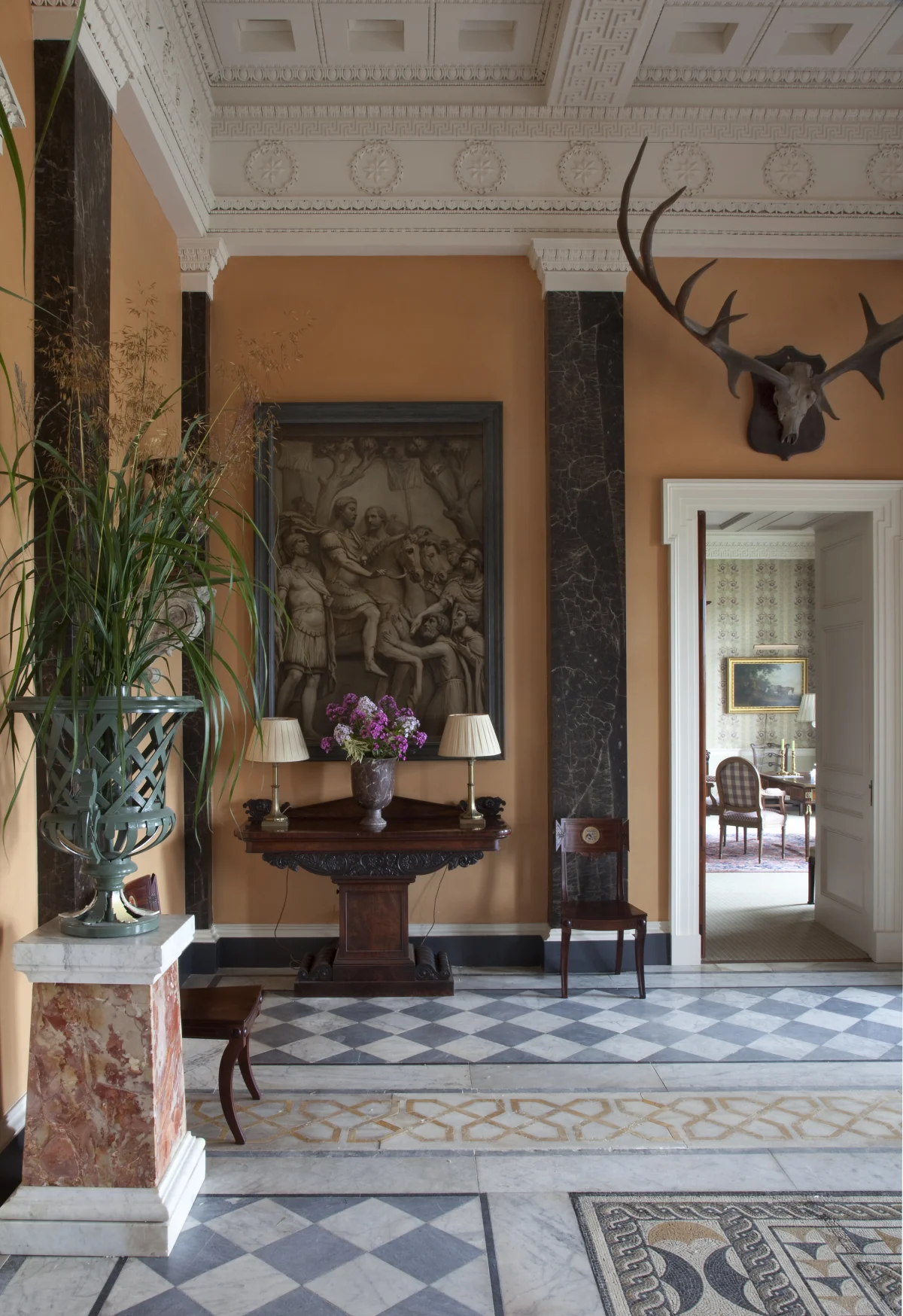
Inside, the rooms the architects built are still the stars: the Saloon, the eighty-foot library running the length of the south front, and the gilded Gold Drawing Room. The parquet floors alone are worth the trip — they lay hidden under decades of varnish until a conservator brought them back. Ireland has other great houses; Adare Manor is the obvious rival, and a very different, more resort-scaled experience. Ballyfin is the intimate one.
What do you do all day at Ballyfin?
As little or as much as you like — that’s the honest answer, and it’s the point. The estate has Ireland’s largest man-made lake, and you can row out on it, or take a horse-drawn carriage around the grounds, or fly a hawk with the falconer, or shoot clays, or walk the restored walled gardens and never see another guest. There’s a spa if the weather turns, which in Ireland it will. My advice is to book one activity a day and leave the rest of the hours for the fire, a book from the library, and a long bath.

Dinner is the evening’s event. The kitchen leans hard on the estate’s own gardens and orchards — a lot of what’s on the plate at night was pulled that morning — and the tasting menu in the dining room is one of the best meals in the country. Lunch is a lighter, sun-filled affair in the Conservatory, and there’s a proper cellar bar for a nightcap. You will not leave hungry, and you will not leave in a hurry.
How to put the week together
Fly into Dublin, drop your bags at The Merrion, and give the city two nights so the jet lag wears off before the good part. On the morning you leave, drive southwest — it’s a little over an hour to Ballyfin — and time your arrival for lunch so you get a full first afternoon on the estate. Give the house a minimum of two nights; three if you can, because the first day is for exploring and the second is for doing nothing, which is the day people remember.
The best months are May, June, and September — long daylight, the gardens at their best, and Dublin without the deep-summer crush — though Ballyfin by the fire in November has its own strong argument. If you’ve got more time, this itinerary extends naturally: hop the Irish Sea for Scotland and its whisky country, or point north entirely and build something like our Iceland itinerary. But honestly, Dublin and Ballyfin on their own make a full, satisfying week.
What You Actually Want to Know
How far is Ballyfin from Dublin? A little over an hour by car, southwest into County Laois. The hotel can arrange a private transfer, which is what I’d do rather than pick up a rental car just for the drive — you’ll want a driver on the way back anyway after that dinner.
How many rooms does Ballyfin have? Twenty-one, each named for a person from the house’s history, and all individually designed. Because it’s so small, it books up far ahead — especially for full-house buyouts and holiday weeks. Reserve months out.
The Merrion or The Shelbourne in Dublin? The Merrion for quiet, art, and a garden; The Shelbourne for the grand, sociable, on-the-Green energy. Both are five-star and central. I book more couples into the Merrion and more first-time visitors into the Shelbourne.
When is the best time to go? May, June, and September for the long days and the gardens. Ireland is wet in every season, so pack for it and plan indoor pleasures — tea, the spa, the library — around the showers rather than fighting them.
Is Ballyfin good for families? It can be, particularly on an exclusive-use basis, but it skews toward adults and couples and has policies around children that shift by season. Tell me who’s traveling and I’ll confirm the current rules before we book.
Ireland rewards the people who slow down for it, and this is the trip that lets you — a little grandeur in the city, then a great house and a lake all to yourself. Tell me where you want to go, and I’ll build it.
Plan Your Next Journey
Work with a Noon Travel advisor for a trip that exceeds every expectation.
Get Started