
The short version
José Ignacio is the best beach town in South America, and this is the winter to go: American's nonstop from Miami to Montevideo returns December 3. Stay at Playa Vik or Posada Ayana in the village, Fasano in the hills above Punta del Este, and give Garzón a full day. Go in March if you can; book January now.
There is a lighthouse at the end of a dirt road, a fish restaurant on the sand, and a village of low white houses where nobody has built anything taller than two storeys since the lighthouse went up in 1877. In January the people at the next table are from Buenos Aires, São Paulo, Paris and Tribeca, and they are all barefoot. That is José Ignacio, forty kilometres up the coast from Punta del Este, and it is the most quietly glamorous beach town in the Americas.
Uruguay has been the Argentines' summer secret for a century and the Brazilians' for thirty years. Americans mostly missed it, partly because getting there meant a connection through Buenos Aires or São Paulo. That changes on December 3, 2026, when American Airlines brings back its seasonal nonstop from Miami to Montevideo: a 787 leaving at 10:55pm, landing at 10:10am, daily until March 2 and then three times a week until March 28. Nine hours, one flight, and you are two hours from the sand.
This guide covers the coast the way we book it: the village of José Ignacio and its three Vik houses, Fasano's estate in the hills behind Punta del Este, a day in Garzón with Francis Mallmann's fires and the sierras beyond, and the wine lodge on the other side of the country that is worth the detour. Every property here is one we would put a client in tomorrow.
Is Uruguay worth it for a luxury beach trip?
Yes, if you want the Hamptons with better light, better beef and a tenth of the traffic. No, if you want a resort with a swim-up bar and a spa menu the length of a novel. Uruguay's coast is about houses rather than hotels, long lunches rather than programmes, and a summer season that runs hard from the day after Christmas through February and then goes soft and golden in March.
The country is small, safe, stable and expensive by South American standards, which is precisely why the people who could summer anywhere summer here. Punta del Este is the big resort town, with high-rises, casinos and a marina. La Barra and Manantiales, just east of it, are where the beach clubs and the younger crowd are. José Ignacio, past all of that at kilometre 182 of Ruta 10, is where it goes quiet: a peninsula with the Atlantic on three sides, a rough beach (Brava) on one flank and a calm one (Mansa) on the other, and the lighthouse in the middle.
The airport question decides the shape of the trip. Punta del Este's own airport, Laguna del Sauce, is thirty minutes from José Ignacio and takes daily flights from Buenos Aires and São Paulo plus private jets around the clock. Montevideo's Carrasco, where the Miami flight lands, is roughly two hours away by car. Land at 10am, and you are having lunch on the beach at La Huella by one.
Where should you stay in José Ignacio?
In one of the Vik houses or at Posada Ayana. Nothing else in the village competes, and the choice between them is a question of temperament: art and architecture at Playa Vik, a beach and bungalows at Bahia Vik, horses and pampa at Estancia Vik, and a small, sunny, grown-ups-only posada with a James Turrell installation in the garden at Ayana.
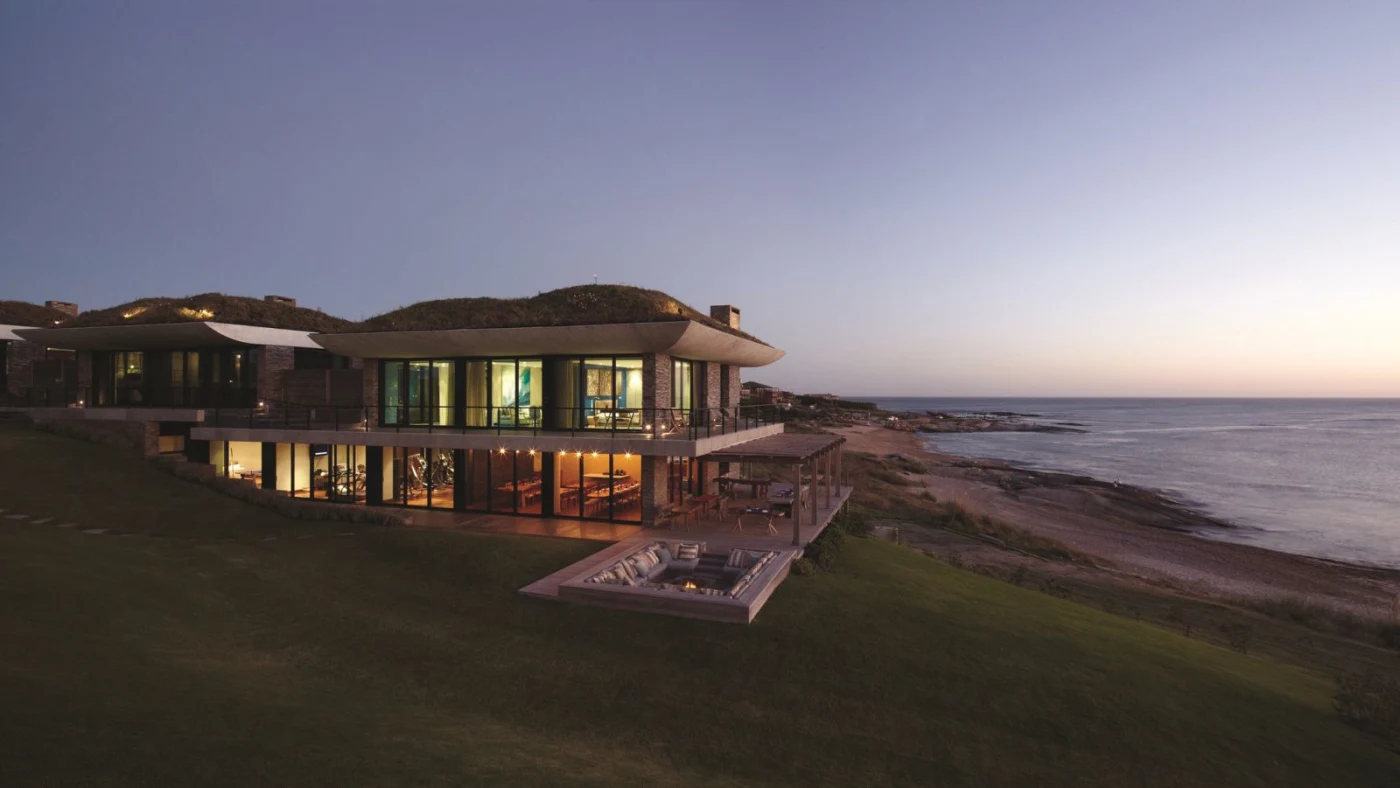
Playa Vik is the one on the postcard. Alex and Carrie Vik built it with Uruguayan architect Carlos Ott on the Mansa beach: a central "Sculpture" building with a fifty-five-foot inclined glass wall, titanium-panelled roof and a bronze door by Pablo Atchugarry that riffs on Ghiberti's Baptistery doors in Florence, flanked by six grass-roofed casas of two or three bedrooms each with their own gardens. The three master suites are in the Sculpture itself; the rest of the rooms are in the casas. The pool is a seventy-five-foot cantilever of black granite hanging over the beach, with a map of the southern sky set into its floor in fibre optics. Ask for a casa; they are the private version of the place, and the retractable glass walls mean the garden is part of the room.
Cielomar, the restaurant, is family-style and entirely gluten-free, which tells you something about the clientele. Half a mile up the beach is La Susana, the Viks' beach restaurant, where lunch runs into a DJ set at sundown and people end up dancing in the sand. Both Vik beach houses are a short walk from the village.

Bahia Vik is the family-and-friends version, half a mile along the same beach. Ten suites in the main house, each done by a different Uruguayan artist, and fifteen bungalows tucked into the dunes, from two-bedroom pavilions with a living room up to a pair of five-bedroom houses that a family can take whole. The dunes and beach grass do the job of walls between them. Its spa, The Shack, sits a few steps from the sand and runs on movement, a cold plunge and sound bowls rather than a menu of facials. If you are travelling as a group, this is where we put you.
Estancia Vik is the third house and the one people forget to book, which is a mistake. It sits on 4,000 acres of rolling country five and a half miles inland, where the José Ignacio stream meets the lagoon, and it looks exactly like an estancia should: white adobe walls, a red tin roof, and courtyards linked by covered walkways. Inside are twelve suites split across two wings, a living room with a twelve-foot white marble Atchugarry under a ceiling painted by Clever Lara as a satellite view of Uruguay, a brick-vaulted dining room built without mortar, a polo field, grass tennis courts and a herd of Criollo and Quarter horses. The twenty-metre pool is the same black stone as Playa Vik's, with the same constellations in the floor. Ride out with the gauchos in the morning, drive down to the beach for lunch, come back for the asado. Three nights here and three at Playa Vik is the itinerary we write most often.

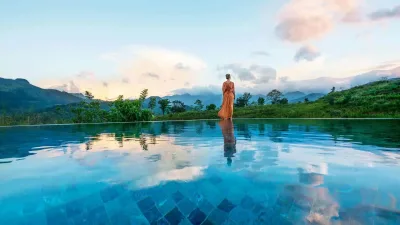
Posada Ayana is the small one, and for a couple it may be the best of all. Eight rooms, adults only, a short walk from the lighthouse, furnished with restored 1950s and 60s pieces its owners Robert and Edda Kofler hunted down in Montevideo and Buenos Aires in homage to Bardot-era Saint-Tropez. The sixteen-metre pool is green marble and salt water. And in the garden is Ta Khut, the first freestanding Skyspace James Turrell built in South America: a white dome of forty-two tons of Lasa marble on a grass-covered plinth, where a forty-five-minute light sequence plays at sunrise and sunset and the sky in the aperture turns colours it has no right to be. Guests see it at private times, free. Ayana closes for the southern winter and reopens on October 29, 2026; superior rooms start at US$435 and the three suites, at 40 to 58 square metres, are the ones to hold.

What about Punta del Este itself?
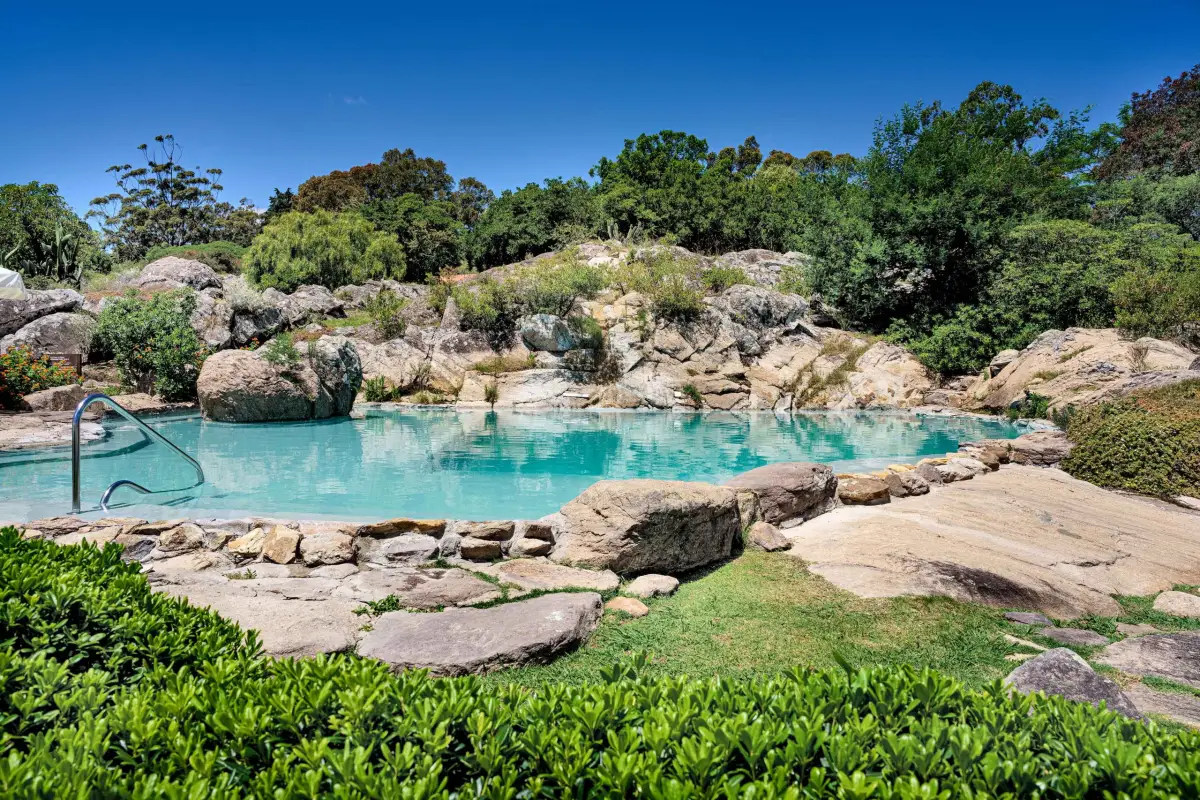
Stay above it, not in it. Hotel Fasano Punta del Este sits on 490 hectares of granite and pasture on the Maldonado River behind La Barra, and it is Isay Weinfeld's best work outside Brazil: thirty stand-alone bungalows and two three-suite villas scattered across the hillside, plus ten apartments in the newer Locanda building, all glass and rough stone, all facing the countryside Gero Fasano calls a cross between Tuscany and the English countryside. The pool is carved into a natural rock outcrop. The restaurant is cut into the rock too, on one of the highest points in the country, and serves the Fasano family's Italian cooking to a room that has flown in from São Paulo for the weekend.
The estate, Las Piedras, has an eighteen-hole Arnold Palmer course, a full equestrian centre with polo fields, two tennis courts, a kids' club and a farm, and in summer a beach club on La Barra with sun beds and lunch for guests. The newest addition is the Golf Villas, three-suite houses by Carolina Proto with their own pools overlooking the course, for families who want to be at Fasano without sharing it. Book four nights and the fourth is free under the hotel's standing One More Night programme, which is the rare hotel promotion worth mentioning in print.
Where do you eat, and is Garzón worth the day?
Garzón is worth the day, and La Huella is worth the trip. Parador La Huella opened on José Ignacio's Brava beach in December 2001 as a shack with a grill, and it is still, on the surface, a shack with a grill: wood, sand, a wood-fired oven, whole fish and lamb over embers, and a table you will need to have arranged well ahead of you in January. It has been a fixture on the Latin America's 50 Best list for years and it has not changed its manner, which is why the same families come back every summer. Lunch at two, swim, lunch continues.
Half an hour inland, past the José Ignacio roundabout and across Ruta 9, is Bodega Garzón, the winery that Alejandro and Bettina Bulgheroni built with the Italian winemaker Alberto Antonini and opened as the first LEED-certified winery outside North America. It is a gravity-fed, wind- and solar-powered building of 19,050 square metres set into terraced hills, and its Tannat and Albariño are the reason serious people now say "Uruguay" in the same sentence as "wine". Francis Mallmann is culinary director; the 120-seat restaurant cooks over open fires on a terrace over the vines, with lunch seatings from 12:30 to 3pm. Book the Fires Menu at least a day ahead, and taste Balasto, the estate's flagship blend, which is now sold through the négociants of the Place de Bordeaux.

The village of Pueblo Garzón itself is a few blocks of low houses around a plaza, and it is where Mallmann has a five-room hotel and restaurant of his own in the old general store. Deeper in the sierras to the west, about an hour from the beach, is Sacromonte, a vineyard in the Sierra de Carapé where MAPA Architects scattered mirrored glass cabins across the slopes so that each one reflects the hills and disappears. The hotel now runs just four of them, named Viña, Lago, Sierra and Horizonte, each with a private heated plunge pool and an electric buggy to reach the restaurant at 320 metres. The land is eighty percent untouched native forest, with capybaras and deer wandering through the vines. TIME put it on its World's Greatest Places list; we put couples here for the two nights between the beach and the flight home.

When should you go?
The season runs from the week after Christmas through February, January is the peak, and March is the month we send people who do not need to be seen. From December 26 to about January 10, José Ignacio is full: every house rented, every table at La Huella spoken for, and rates at their annual high. It is also the most fun the town gets, and if that is the point of the trip, book it now, because the houses fill from September.
February is still summer, still busy, and slightly easier. March is the insider's answer: the sea at its warmest after two months of summer, daytime highs in the mid-twenties Celsius, the restaurants still open and the beach half empty. The Miami nonstop runs daily until March 2 and then Mondays, Thursdays and Saturdays until March 28, so a late-February or early-March week lines up perfectly. Posada Ayana opens October 29 and closes after March; the Vik houses and Fasano run year-round, and Fasano in particular is a very good autumn hotel when Punta del Este goes back to being a quiet town.
Should you add Carmelo or Buenos Aires?
Add Buenos Aires; add Carmelo only if wine is the point. Montevideo to Buenos Aires is a short flight or a ferry, and pairing four nights on the Uruguayan coast with three in Recoleta or Palermo is the natural South American week. Our Buenos Aires guide covers where to stay, and if you have a second week, Buenos Aires is also the gateway to Patagonia.
Carmelo is on the other side of Uruguay, on the Río de la Plata across from Argentina, and is easier reached from Buenos Aires than from José Ignacio: an hour and a quarter on the Buquebus fast ferry to Colonia del Sacramento, then a little over an hour's drive west. The reason to go is Narbona Wine Lodge, five adults-only rooms attached to a working winery and dairy, three looking onto the winery and two onto the vines, each with a king bed, a terrace and a wood stove or a clawfoot tub. Narbona makes its own Tannat, cheese and dulce de leche, and if the name is familiar to Miami readers it is because the family runs restaurants in Key Biscayne, Coconut Grove and Boca Raton. For a wine-country week rather than a beach week, read it alongside our Mendoza guide and decide which side of the Andes you want.
What You Actually Want to Know
How do you get to José Ignacio from the United States?
From December 3, 2026 to March 28, 2027, American Airlines flies nonstop from Miami to Montevideo overnight, about nine hours, daily until March 2 and then three times a week. From Carrasco airport it is roughly two hours by car to José Ignacio. The rest of the year you connect through Buenos Aires, São Paulo, Panama or Lima, or fly into Punta del Este's own airport from Buenos Aires or São Paulo.
Is José Ignacio expensive?
In January, yes: it is priced like the Hamptons or Saint-Tropez in August, and the best houses sell out months ahead. Posada Ayana's published rates start at US$320 for a standard room and US$435 for a superior; the Vik houses and Fasano price by season and are considerably more in peak weeks. March brings real relief without losing the weather.
Which Vik hotel is best?
Playa Vik for a couple who care about design and want to be on the beach; Bahia Vik for a family or a group who want bungalows and a spa; Estancia Vik for horses, polo and quiet. The three are within six miles of each other and share a reservations desk, so a split stay is easy to arrange.
Do you need a car in José Ignacio?
In the village, no; everything is walkable and the hotels run you to the beach. For Garzón, Sacromonte, La Barra and the airport, yes, or have your hotel arrange a driver. Distances are short and the roads are good, but the dirt roads into the sierras are dark at night.
Is Uruguay safe for luxury travellers?
Uruguay is consistently ranked among the safest and most stable countries in Latin America, and the coast east of Punta del Este is as relaxed as anywhere we send clients. Normal city precautions apply in Montevideo; in José Ignacio, the main hazard is the Brava surf.
Noon's advisors have stayed in every property on this list and know which casa, which bungalow and which March week to hold. Tell us where you want to go.
Plan Your Next Journey
Work with a Noon Travel advisor for a trip that exceeds every expectation.
Get Started