
The short version
Milan rewards travelers who come for design, not just the shopping. Base yourself at Portrait Milano, the Bulgari, or the Four Seasons, then spend your days at Fondazione Prada, Villa Necchi Campiglio, and the Triennale. Come in April for Salone del Mobile, or September for the same city with room to breathe.
Most people treat Milan as a connection. A night before the lakes, a shopping afternoon before a flight, a place to change trains on the way to somewhere prettier. I send my design-minded clients here on purpose, and I give them three or four days to do it properly.
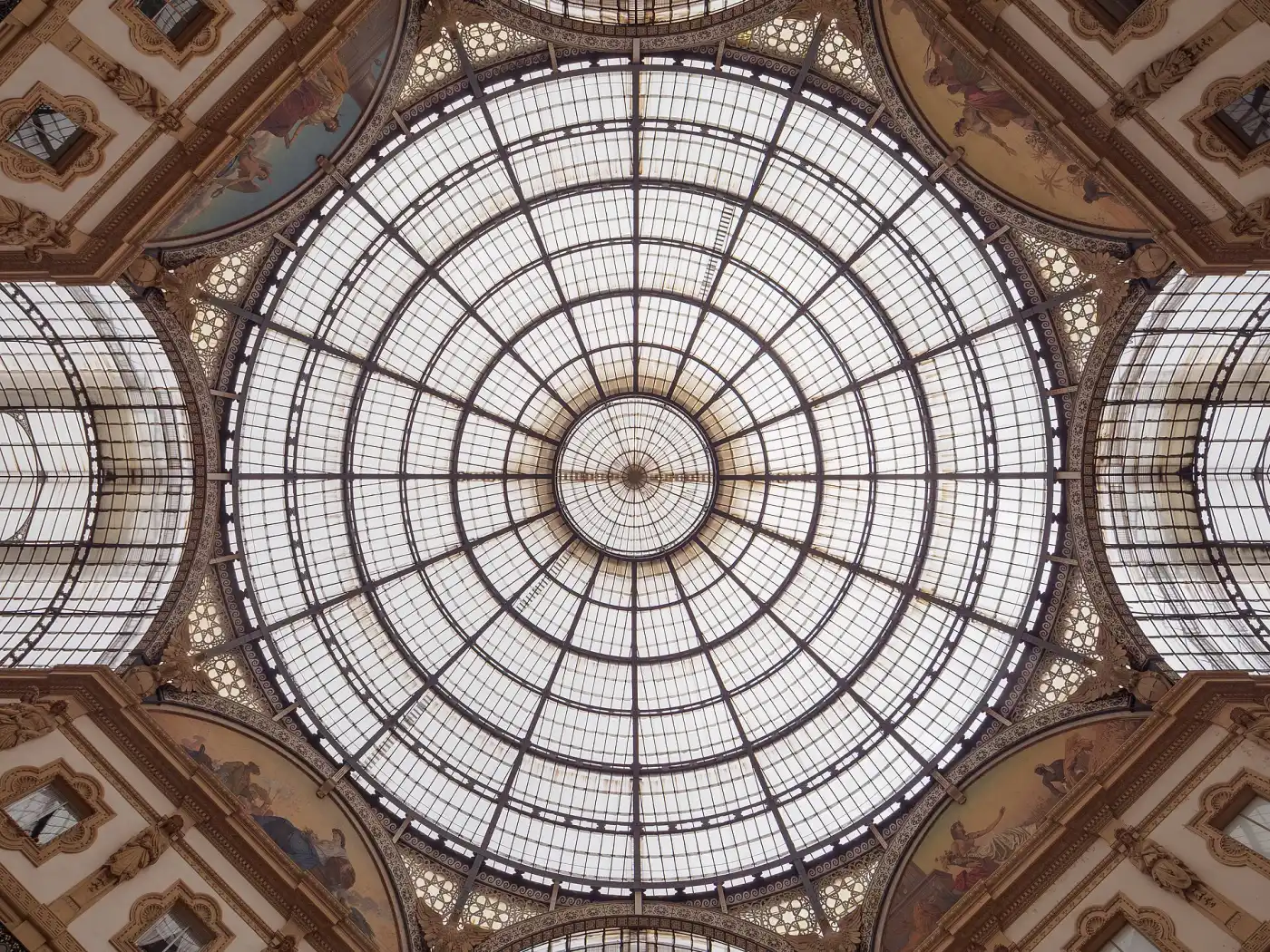
The city hides itself. The great Milanese interiors sit behind plain street doors, and the courtyards worth seeing are the ones you only reach if you know which bell to ring. Even the Galleria Vittorio Emanuele II — the iron-and-glass arcade off the Duomo that every guidebook photographs — is really a lesson in how this city has always married engineering to elegance.
This is where I put people who care about how a room is put together, and what I send them to see once they drop their bags. It pairs neatly with the other design cities I love: if this is your kind of trip, you already know the type.
Which Milan hotel should you book for design?
For a first design trip, I book Portrait Milano. It opened in December 2022, the sixth hotel from the Ferragamo family’s Lungarno Collection, inside the former Archiepiscopal Seminary — a 1564 complex the public had never been allowed to enter. Michele De Lucchi’s studio, AMDL CIRCLE, led the restoration; the interiors are Michele Bönan. There are 73 rooms and suites, but the real coup is out front: the Piazza del Quadrilatero, a roughly 2,800-square-meter courtyard ringed by a double colonnaded loggia, opened as a public passage between Corso Venezia and Via Sant’Andrea. Ask for a room over the courtyard, and use the spa tucked beneath the piazza. It is the most confident new opening in the city, and it sits right on the edge of the shopping quarter.
Is the Bulgari or the Four Seasons the better base?
It comes down to whether you want a garden or a cloister. The Bulgari Hotel Milano (opened 2004, in Brera) is built around a 4,000-square-meter private garden beside the city’s Botanical Garden — the work of ACPV Architects, Antonio Citterio and Patricia Viel, all black Zimbabwe marble and Vicenza stone, with 61 rooms including 13 suites. In a dense city, that garden is the entire argument. The Four Seasons Hotel Milano on Via Gesù is the opposite mood: a 15th-century convent converted in 1993, with Renaissance frescoes, a colonnaded cloister, and an oval spiral staircase, 118 rooms and 50 suites, dropped right into the middle of the Quadrilatero’s shopping streets.
Two more worth knowing. The Mandarin Oriental, Milan threads five connected 18th-century buildings on Via Andegari, again with Antonio Citterio interiors, 70 rooms and 34 suites, a few steps from La Scala; its Seta restaurant, led by chef Antonio Guida, is one of the best tables in the city. And the Park Hyatt Milano, designed by Ed Tuttle in a building from 1870 on Via Tommaso Grossi, looks straight into the Galleria — 106 rooms and 25 suites, and the pick if you want the Duomo essentially at your door.
What should you see beyond Montenapoleone?
Start at Fondazione Prada, south of the center in Largo Isarco. Rem Koolhaas and OMA reworked a former gin distillery into an art campus that opened in 2015, anchored by the “Haunted House” clad in 24-carat gold leaf and, since 2018, a ten-story exhibition tower. Have your coffee at Bar Luce, the on-site café Wes Anderson designed to look like a 1950s Milanese bar — it photographs exactly how you think it will.
Then Villa Necchi Campiglio, Piero Portaluppi’s rationalist house built between 1932 and 1935 and now run as a museum by FAI. You may recognize it as the set of the film I Am Love; in person it is the clearest window into how Milanese industrialists actually lived, down to the veranda and the heated pool. For contemporary design, the Triennale Milano in Parco Sempione runs the exhibitions worth timing a trip around, and Rossana Orlandi — the gallery hidden inside a former tie factory in the Magenta district — is where the design world actually shops.

If a city built around design is the whole point of a trip for you, Milan belongs in the same conversation as Vienna, Tokyo, and Copenhagen. They reward the same kind of looking.
When should you go, and is Salone worth it?
If design is the reason you’re coming, the answer is April. Salone del Mobile 2026 runs the 21st to the 26th at Fiera Milano Rho, with the citywide Fuorisalone spilling across the design districts from the 20th. It is the best week of the year to see Milan doing what it does — and also the most crowded and expensive, with the good hotels gone months in advance. If you want that week, I book it by winter. If you’d rather have the city with room to breathe, come in late September, when the fashion energy is high and the weather still holds, or in October and November. Skip August, when much of Milan closes and takes its own holiday.
What You Actually Want to Know
How many days do you need in Milan? Three to four. That’s enough for the hotels, the two or three design landmarks that matter, a proper look at the Quadrilatero, and a day trip out to Fondazione Prada without rushing any of it.
Where should a first-timer stay? The Quadrilatero or Brera. Portrait Milano, the Four Seasons, and the Mandarin Oriental put you inside walking distance of nearly everything; the Bulgari sits just north in its garden; the Park Hyatt is best if you want the Duomo and the Galleria at your feet.
Do you need a car? No. Milan is flat, walkable, and well served by the metro. Fondazione Prada is a short taxi or one metro line from the center, and that’s about the furthest you’ll go.
Is Milan worth it if you’re not shopping? That’s the whole premise of this guide. The design, the architecture, and the house museums are the reason to come; the boutiques are just what happens to line the same streets.
Milan is a city that gives more the more you know where to look. Tell me when you want to go and what you want to see, and I’ll build the trip around it.
Plan Your Next Journey
Work with a Noon Travel advisor for a trip that exceeds every expectation.
Get Started