The short version
A Rwanda gorilla permit costs US$1,500 and only 96 are issued in the whole country each day, so book six months out. The permit price never changes; the lodge rate nearly halves in March, April, May and November. Two nights minimum, three if you want a second trek. Minimum age is 15.
On Friday 4 September, in a field at Kinigi under the Virunga volcanoes, Rwanda will give names to 22 baby mountain gorillas. Kwita Izina is in its twenty-first year now, and it has become the clearest annual scoreboard for the only wild great ape population on earth whose numbers are rising. There are roughly a thousand mountain gorillas left in the wild. Just over 600 of them live in the Virunga Massif, the volcanic chain that Rwanda shares with Uganda and the Democratic Republic of the Congo.
Rwanda protects them with a pricing strategy rather than a fence. A permit to spend one hour with a habituated family costs US$1,500, and the country issues only 96 of them per day. That is the entire national supply. Eight people per gorilla family, twelve habituated families, one visit each per day, and then the forest closes. It is the most deliberate scarcity in luxury travel, and it works: ten per cent of permit revenue goes straight to the communities on the park boundary, which is why the people who farm the potato fields below the tree line have a reason to want gorillas alive.
What follows is the part nobody puts in the brochure. What the money buys, when to go if you would rather spend it on the lodge than the season, how hard the walk really is, and which five properties are worth the flight.
What does the permit cost, and what does $1,500 buy?
The permit is US$1,500 per person, per trek, issued by the Rwanda Development Board. It covers park entry, the guides and trackers, and a strict maximum of one hour in the presence of the gorillas. It does not cover your driver, your porter, your lodge, or a second attempt if the weather turns. Permits can be booked directly through Rwanda’s Irembo platform or, more sensibly, through your lodge or advisor, who will hold them against your dates before you commit to flights.
Six months is the right lead time for June to September and for the Christmas fortnight. The maths is unforgiving: 96 permits a day nationwide, against every lodge bed in Musanze plus the day-trippers driving up from Kigali. Kwita Izina week in early September is the tightest of all.
Everyone gathers at park headquarters in Kinigi at 7am. You are briefed, then allocated to one of the twelve habituated families — Susa, Igisha, Karisimbi, Sabyinyo, Amahoro, Agashya, Kwitonda, Umubano, Hirwa, Bwenge, Ugyenda or Muhoza — according to your fitness. This is the single most consequential thirty seconds of the trip, and it is where a good guide earns their fee: they know the rangers, they know which family slept where last night, and they can make the case for the allocation you want. The minimum age is 15, with no exceptions, and drones are illegal everywhere in Rwanda.

When should you go, and what does the season do to the price?
Trekking runs year-round. Rwanda sits just south of the equator at around 2,600 metres here, so the temperature barely moves; what changes is how much water falls out of the sky. The long dry season runs June to mid-September, the short dry season December to February. The long rains are March to May, with a shorter wet spell in October and November.
Here is the piece that matters, and almost nobody says it out loud. The permit costs $1,500 on every single day of the year. The lodge rate does not. At Virunga Lodge, a standard banda is $2,205 per person per night in high season and $1,220 in low season. At Wilderness Sabyinyo, the same room is $2,235 in June and $1,689 in November. At Singita Kwitonda, a suite falls from $3,630 to $2,720. For a couple doing two nights and one trek each, choosing November over July saves roughly the cost of both permits.
What you buy with the high season is drier ground underfoot and better odds on a clear volcano at sunrise. What you buy with the shoulder is mud, cloud, and a materially better hotel for the same money. The gorillas do not migrate and do not care. If you are fit and you own proper boots, late October to mid-December is the sharpest value window in East Africa.
Where should you stay?
Everything sits within about half an hour of the Kinigi park gate, in the Musanze district. Getting there from Kigali is a road transfer of up to four hours through the terraced hills, or a helicopter in thirty minutes. Book two nights minimum. Three if you want two treks, and you should want two treks — the second one is when you stop photographing and start watching.
Wilderness Bisate Reserve, for the ones who want the forest to themselves
Four villas of 212 square metres each, on a slope deep enough into the reforested land that you cannot see the sister lodge a short walk away. Every excursion is private. Each villa has a wood-fired hot tub on its own deck, and the main building runs to three fireplaces, a climate-controlled wine tower and a mud room built specifically for the state you return in. Architectural Digest put it on its Great Design Hotel list for 2025. Rates are $4,929 per person per night from June to October and again from mid-December, dropping to $3,549 for the first half of November. Two of the villas link, which makes it the best family answer in Rwanda for those with teenagers old enough to trek.
Singita Kwitonda Lodge, for the ones who want the view and the wine cellar
Nine one-bedroom suites and two two-bedroom suites built from volcanic rock, river stone and clay brick made by the surrounding villages, looking straight up at Sabyinyo, Gahinga and Muhabura. Every suite has a heated plunge pool and indoor and outdoor fireplaces. Rates run $3,630 per adult per night in high season and $2,720 in the shoulder, including all meals and premium drinks. Two details worth knowing before you book: you are required to take a private driver-guide and vehicle for every day of your stay, which is not in the headline rate, and Singita explicitly advises against trekking on your departure day. Add the night. For a family or a group of eight, Kataza House takes the whole thing private.
One&Only Gorilla’s Nest, for the ones who want a resort
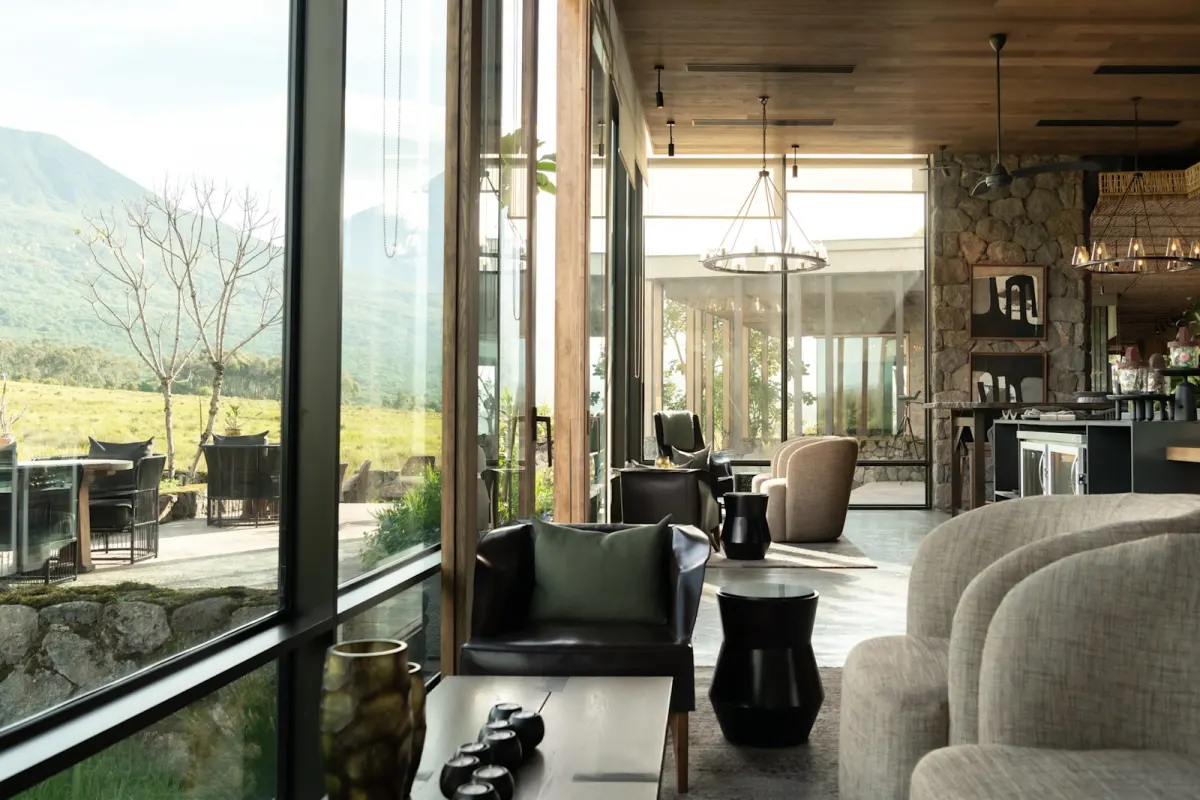
Twenty-one lodges and suites in a eucalyptus forest, and the only property up here that behaves like a resort rather than a camp — spa, pool, the full apparatus. The scale is the differentiator: the Ingagi Suite runs to 251 square metres, and the Silverback Suite to 402, with a private pool and an open-air lounge built around a firepit. If half your party is trekking and half is not, this is the one that keeps everybody happy.

Wilderness Sabyinyo, for the ones who care where the money goes
Stone cottages with fireplaces and verandas on a 16-hectare property fifteen minutes from park headquarters, and the most interesting ownership structure in Rwandan tourism: the lodge belongs to SACOLA, a community trust, and is operated by Wilderness. It was the country’s first community-owned lodge. It is also the cheapest genuinely good bed on the mountain, at $2,235 per person per night in high season and $1,689 in November. If your instinct is that the trip should leave something behind, this is the most direct version of that instinct available.

Virunga Lodge, for the ones who want the original
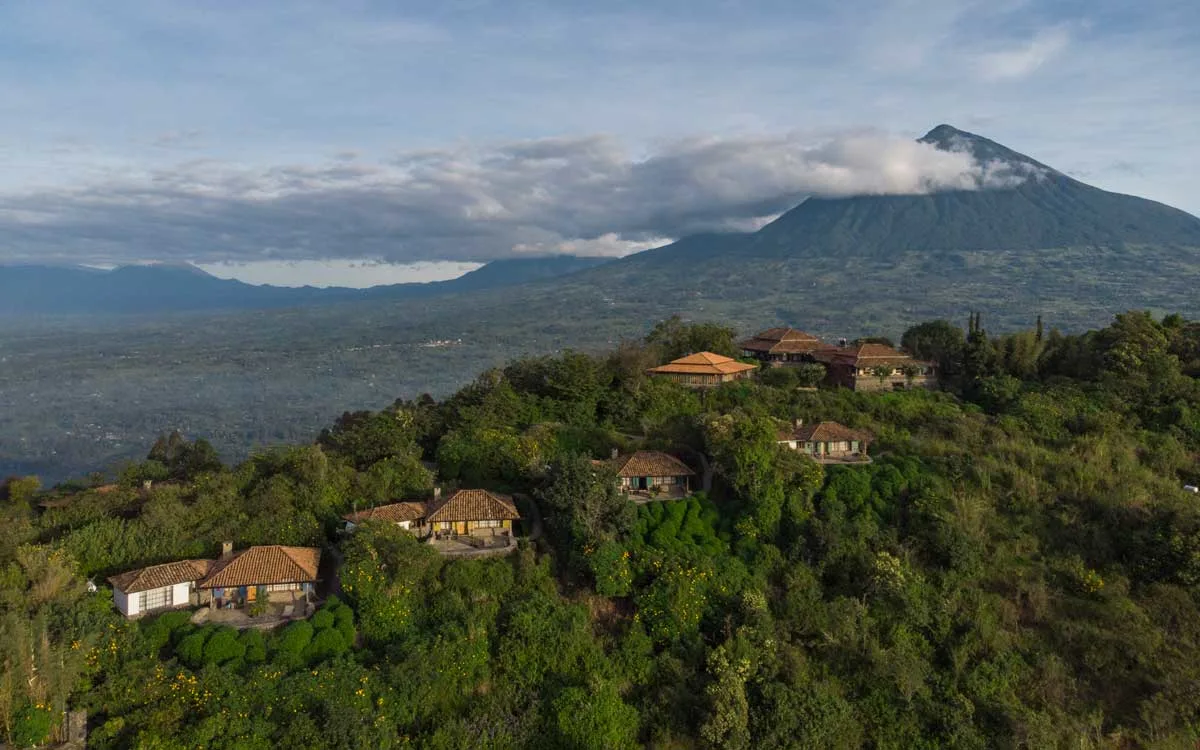
Praveen Moman built this in 2004, before any of the others existed, on a ridge with the Virunga volcanoes on one side and Lake Bulera and Lake Ruhondo on the other. Twelve hand-built bandas, four of them deluxe, all with private terraces, and a personal butler. The Dian Fossey Map Room, opened in 2017, holds a permanent exhibition on the explorers and conservationists of these volcanoes from 1850 to Fossey’s death in 1985 — the best hour of context you will get anywhere in Rwanda, and worth a night on its own. Rates start at $1,220 per person in low season, plus a $50 per night community and conservation levy. It is the furthest from the park gate, which means an earlier alarm, and the compensating view is the finest of any lodge here.
How hard is the trek?
Harder than the photographs suggest and easier than the internet claims. The walk to a family can be thirty minutes or it can be four hours, at altitudes between 2,500 and 4,000 metres, through bamboo and nettles on volcanic soil that holds water like a sponge. There is no path. Rangers cut one with machetes as you go.
The altitude is the part people underestimate. If you have come from sea level and slept two nights at 2,600 metres, a steep hour will feel like two. Hire a porter — every lodge will arrange it, it costs very little, it puts money directly into the local economy, and having someone haul your camera bag and physically pull you up a wet bank is the difference between enjoying the hour and enduring it.
Wear waterproof boots with ankle support, gaiters over them against the nettles, gardening gloves, and a rain shell you can get into quickly. The better lodges keep a gear room stocked with all of it, so do not buy gaiters for one week of your life. Once you reach the family, you keep seven metres back, you do not eat or drink, and you do not touch them even if a curious juvenile touches you.

What else is worth doing while you are there?
A second permit is the obvious answer, and the right one. Beyond that: golden monkeys, endemic to these volcanoes, are a gentler and much cheaper trek, and the right choice for a 12-year-old too young for gorillas. The hike to Dian Fossey’s grave is a half-hour drive from park headquarters followed by two to three hours of climbing to above 3,000 metres, ending at the Karisoke site where she worked and is buried beside the gorilla Digit. It is a serious walk and an unusually moving one.
Give Kigali a night rather than treating it as an airport. The Genocide Memorial deserves unhurried time, and the city’s coffee and design scenes have quietly become the reason people extend. If you want a two-country trip, Rwanda pairs neatly with a savannah leg — Akagera in the east, or a flight across to Kenya. We have written separately about Kenya’s newest safari camps and about the Okavango Delta, either of which balances the gorillas with big-game plains.
Why is the park about to get bigger?
Volcanoes National Park is small — 160 square kilometres, hemmed in on all sides by some of the densest rural farmland in Africa. Rwanda is now expanding it by 37.4 square kilometres, a 23 per cent increase, with a further 6,620-hectare buffer zone. The stated cost is $300 million, and around 3,400 families are being resettled into purpose-built green neighbourhoods rather than simply moved off the land. The targets are a 15 to 20 per cent rise in the gorilla population, a halving of infant mortality and an 80 per cent reduction in conflict between gorillas and farmers.
It is the largest bet any country has placed on a single species, and it is funded substantially by the permits. The private sector is inside it too: Wilderness sits alongside the African Wildlife Foundation, the Dian Fossey Gorilla Fund, Gorilla Doctors and the International Gorilla Conservation Programme as project partners. If you want to understand how a lodge company can function as a conservation instrument rather than a guest of one, read our piece on the Singita model — the same logic runs through Kwitonda, on the boundary of this park.
Practically, it means the trek you book in 2030 will start from a different tree line than the one you book now. That is not a reason to wait.
What You Actually Want to Know
How far in advance should I book?
Six months for June to September and for the Christmas and New Year period. Three to four months is usually workable in the shoulder seasons. Permits and lodge beds should be held together; there is no point having one without the other.
How many nights do I need?
Two nights buys one trek and is the minimum that makes sense. Three nights buys two treks, which is what most people wish they had booked. Do not schedule a trek on your departure day — the walk can take most of the day door to door, and the lodges advise against it.
Is there a direct flight?
Not from North America. Kigali is served non-stop from Doha by both RwandAir and Qatar Airways, from London Heathrow and Paris by RwandAir, from Dubai, and seasonally from Brussels and Istanbul, with KLM adding Amsterdam. One connection is the realistic best case.
Rwanda or Uganda?
Uganda charges $800 for a Bwindi permit, and $600 in April, May and November, against Rwanda’s flat $1,500. Bwindi is denser, steeper forest. Rwanda is the answer if your time is the expensive part: the park is under four hours from an international airport, the lodges are materially better, and the road, the briefing and the ranger service are the most organised in the region.
What if we do not find them?
You almost certainly will. Every habituated family is monitored daily by trackers who report its position to the guides, which is why the walk is long rather than uncertain. Sightings are not guaranteed in writing, but failures are rare enough that no lodge treats it as a live risk.
Can children go?
Not under 15, anywhere in Rwanda, and the rule is enforced at the gate. Golden monkey trekking is open from 12. Most lodges welcome younger children and will provide childminding while the adults trek; Virunga Lodge sets its own minimum age of 12 for staying at the lodge at all.
Rwanda is the rare trip where the constraint is not money but arithmetic. Ninety-six people a day, twelve families, one hour each. If the Kwita Izina window or the December holidays are what you have in mind, those permits are being spoken for now. Noon holds the permits and the beds together, matches the lodge to the walk you want, and builds the savannah leg around it. Tell us where you want to go.
Plan Your Next Journey
Work with a Noon Travel advisor for a trip that exceeds every expectation.
Get Started