The short version
The cranes land in Phobjikha in late October and the festival is November 11. Bhutan’s tsechus move with the lunar calendar; this one doesn’t. Build ten nights around it: Paro, Thimphu, Punakha, Gangtey for the festival, Bumthang, then fly back for the Tiger’s Nest. Book eighteen months out.
Every advisor who sells Bhutan says the same thing about October: best month, clearest skies, book it. October is fine. November is the one I’d take.
Sometime in the last week of October, several hundred black-necked cranes finish a flight over the Himalaya from the Tibetan Plateau and drop into the Phobjikha Valley. The birds are said to circle Gangtey Goemba three times before they land — a kora, the same circumambulation a pilgrim walks. The valley’s farmers won’t plant winter wheat until the cranes have arrived. When Phobjikha was finally electrified, the power lines went underground so the birds wouldn’t fly into them. On November 11, the monastery courtyard fills with children in crane costumes and the whole valley turns out to welcome them.
I’m building my own trip around it for November 2027. Here is the route, valley by valley, and why it runs ten nights instead of seven.
Why November instead of October?
Because November is the only month that hands you the birds, the festival, and the clearest air of the year at the same time. The cranes are in Phobjikha from late October to mid-February. The festival is fixed to November 11 — which matters more than it sounds, because Bhutan’s tsechu festivals run on the lunar calendar and slide by weeks from year to year. This one you can put on a calendar two years out and book flights around.
The trade is cold. Phobjikha sits at 3,000 metres, where November days run 8–13°C and nights drop below freezing. Paro is milder at 10–17°C by day, near freezing after dark. Punakha, down at 1,300 metres, is the relief: low twenties, sunny, warm enough to eat outside. That 1,700-metre spread is why the itinerary moves the way it does — you drop into the warm valley in the middle and save the highest, coldest nights for the days you’re best acclimatised.
What does the ten-night route look like?
Ten nights, five valleys, one drive on each moving day and nothing longer than six hours. Both Amankora and Six Senses run five lodges across exactly these valleys, so the route works on either circuit.
Nights 1–2, Paro (2,250 m). Fly into Paro, drive twenty minutes to the lodge, and do nothing ambitious. Do not climb the Tiger’s Nest yet. Paro town is where I’d spend the first full day — the National Museum in the old watchtower above Rinpung Dzong, the cantilever bridge at Nyamai Zampa, and Kyichu Lhakhang, which is the oldest thing you’ll see all week.
Night 3, Thimphu (2,350 m). An hour and twenty minutes from Paro. Thimphu gets one night. It’s the capital, and you didn’t come for the capital — you came for what’s past it. Buddha Dordenma in the morning, then go.
Nights 4–5, Punakha (1,300 m). Three hours over the Dochu La pass at 3,100 metres, where on a clear November morning the Himalayan wall is laid out end to end. Then you drop 1,800 metres into fruit orchards and rice paddies. Amankora’s lodge here is a 300-year-old farmhouse built by a former chief abbot, reached on foot across a suspension bridge, with a 29-metre heated infinity pool above the rice terraces — ask for a Mo Chhu Suite, the ones with floor-to-ceiling glass over the river. Six Senses calls its Punakha lodge the Flying Farmhouse and it earns the name. Punakha Dzong, at the confluence of the Pho Chhu and Mo Chhu, is the most beautiful building in the country.
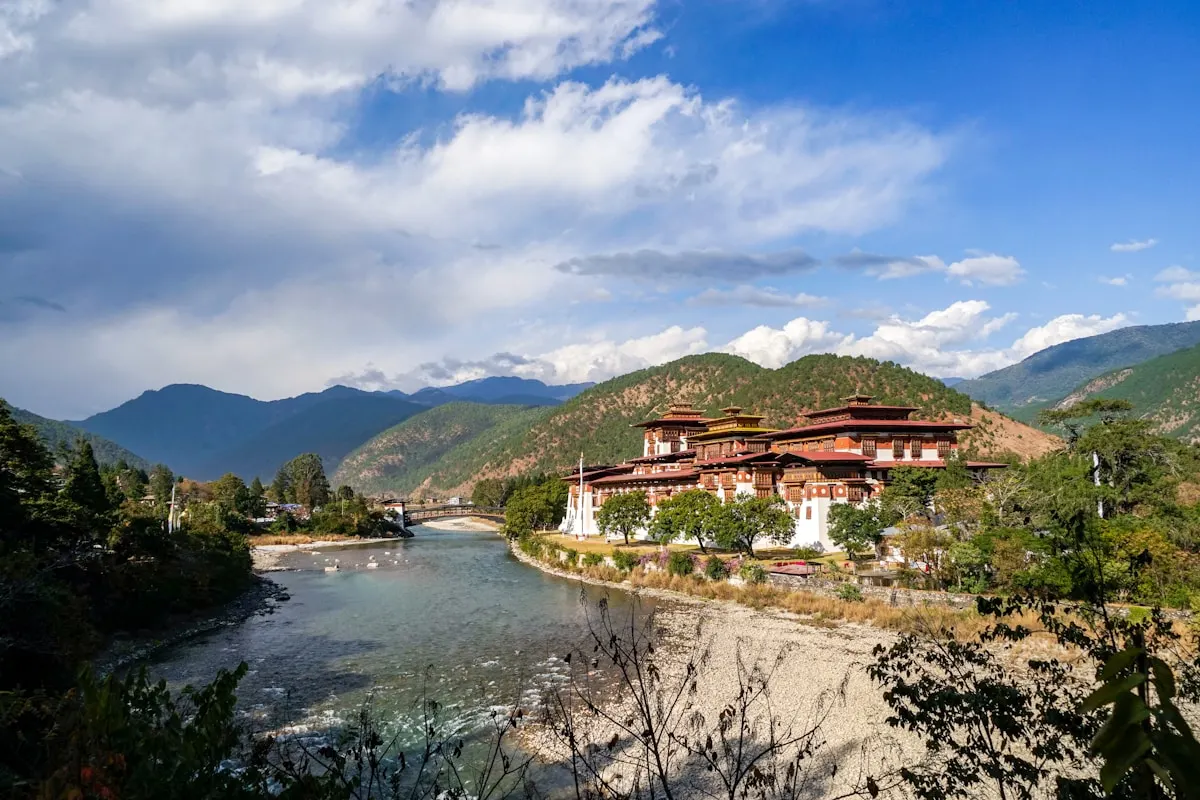
Nights 6–7, Gangtey and Phobjikha (3,000 m). Three hours from Punakha, and the reason for the whole trip. Time your arrival for the 10th so you are in the valley the night before the festival. This is the one valley where I’d choose Six Senses over Aman: the Gangtey lodge is built as a birdwatching bridge with a 180-degree view across the wetlands, eight suites and a two-bedroom villa, and in crane season that window is the entire point. Amankora Gangtey is also lovely — eight suites on a forested knoll looking at the 16th-century Gangtey Goemba, a hot stone bath, and a dinner they serve in a potato shed. Both are tiny. That is the booking problem.
Give the festival the whole morning of the 11th, then spend the afternoon at the RSPN visitor centre, which has spotting scopes trained on the roost. The Phobjikha Conservation Area covers 163 square kilometres and has been managed for the cranes since 2003.

Nights 8–9, Bumthang (2,580 m). Five to six hours east over Pele La — the longest drive of the trip, and worth it. Bumthang is Bhutan’s spiritual heartland, with 29 temples and monasteries in one valley, some dating to the 7th century. It also makes the country’s cheese, honey, apple brandy and only good beer. Two nights, not one.
Night 10, Paro. Fly Bumthang to Paro — 35 minutes from Bathpalathang, fifteen minutes from the lodge — instead of driving the long way back. On Amankora’s circuit that flight is included once you’re staying ten nights or more, along with a second spa treatment. Which is precisely why this trip is ten nights and not seven. It is also the most literal version of staying longer on purpose I can think of: the country prices patience as a discount.
When should you climb the Tiger’s Nest?
On your last morning, not your first. Paro Taktsang sits at 3,120 metres — 10,240 feet — and the round trip takes most people four to five hours, roughly four kilometres each way, with a cafeteria at the halfway point where everyone stops for tea. It is a hike, not a climb; the difficulty is lungs, not legs. After ten nights sleeping between 2,250 and 3,000 metres you will walk up it as a different person than you would have on day two.
November is the best month on that trail — dust-free air, no monsoon cloud, the sharpest views of the cliff you will get all year. Go at first light, before the sun comes over the ridge and before the crowds. Then take the recovery lunch at Amankora’s log cabin, which sits at the base of the climb and exists for exactly this purpose.
Amankora or Six Senses for this trip?
Pick one and run the whole circuit on it. Both brands price Bhutan as a single journey — guide, driver, all meals, permits, transfers between valleys — and both get materially better the longer you stay. Mixing lodges across brands is possible and I have done it for clients, but you lose the journey pricing and pay lodge by lodge, which is a real number.
For this specific November trip: Six Senses if the cranes are the reason you are going, because the Gangtey lodge’s view over the wetlands is unmatched and the wellness programming suits a slow, cold-weather week. Amankora if the Tiger’s Nest is the reason, because Paro Lodge and that log cabin are built around the climb, and because the ten-night inclusions make the long version of this itinerary the sensible one. If you have never stayed with the brand, our primer on a first Aman stay is worth ten minutes first.
What You Actually Want to Know
What will the Sustainable Development Fee cost in November 2027? This is the thing to plan for. The discounted $100 per person per night rate runs through August 31, 2027, after which it is expected to revert to $200. For two people on ten nights, that is the difference between $2,000 and $4,000, plus a one-off $40 visa each. Budget the higher figure and treat any extension as good news. Our full breakdown of what a Bhutan trip costs has the rest of the maths.
How far ahead do I need to book? Twelve to eighteen months for festival week. Amankora Gangtey has eight suites. Six Senses Gangtey has eight suites and one villa. That is seventeen rooms of top-tier inventory in the valley on the one date everybody wants.
Do I need to be fit for the Tiger’s Nest? Reasonably. It is a steady uphill walk at altitude over four to five hours, not a technical ascent, and horses can carry you part of the first section. The people who struggle are the ones who fly in and climb it inside 48 hours.
Can I fly to Bhutan directly? Only on Drukair or Bhutan Airlines, and only into Paro. They connect through Bangkok, Delhi, Kathmandu, Kolkata, Singapore, Dhaka and Dubai, so you will route through one of those and should plan a night on either end.
Is one night in Bumthang really enough? No. Nine out of ten itineraries give it one and it is the cut I argue with most. Two nights, and use the domestic flight home so the driving does not eat the day.
November 2027 is far enough out that everything is still available and close enough that the good rooms in Phobjikha will go this year. Tell me where you want to go, and I’ll build it.
Plan Your Next Journey
Work with a Noon Travel advisor for a trip that exceeds every expectation.
Get Started