The short version
Bhutan charges every visitor a $100-per-night Sustainable Development Fee on top of a $40 visa, so a week for two starts at $1,400 before a single hotel night. Stay at Amankora or Six Senses (roughly $1,300–$1,900 a night, all-in), go in October or April, and climb to the Tiger’s Nest. It is worth all of it.
Most countries want more tourists. Bhutan wants fewer, and charges accordingly. Every foreign visitor pays a $100-a-night Sustainable Development Fee simply for the privilege of being there — a deliberate filter that keeps the Himalayan kingdom from going the way of every other beautiful place that priced beauty too cheaply.
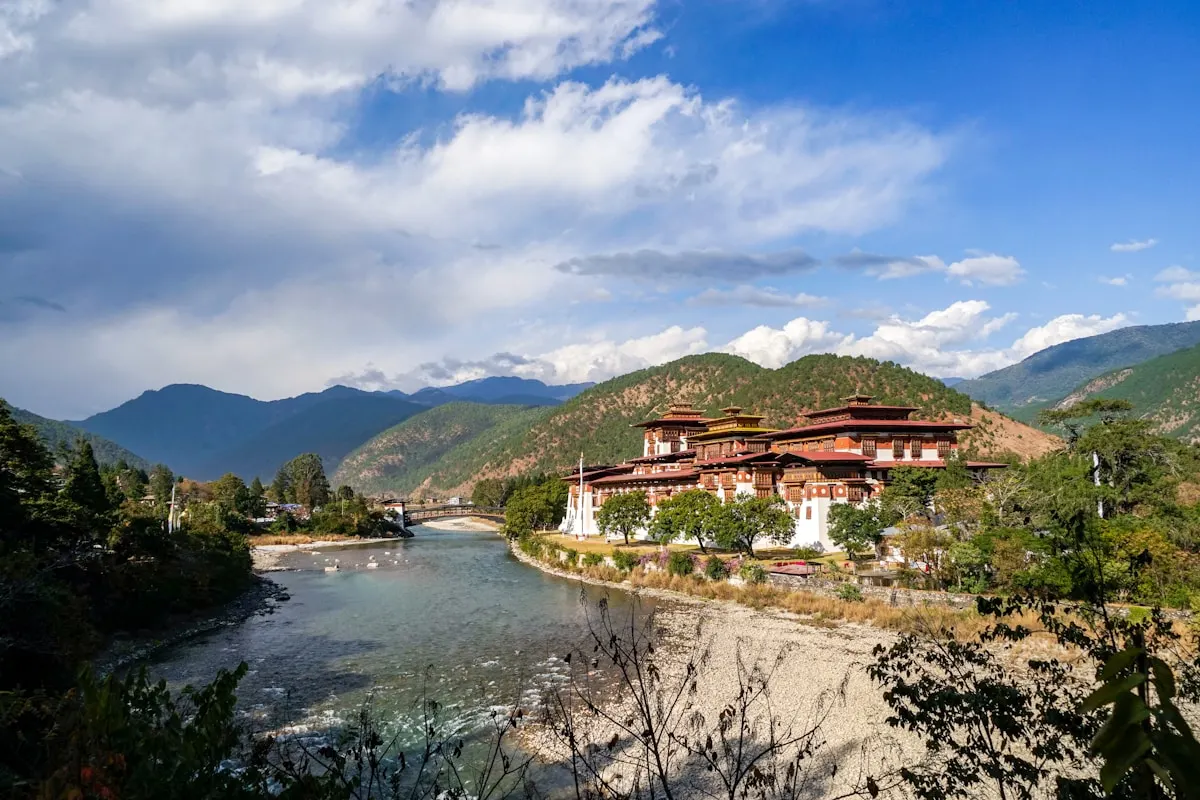
The result is a country of roughly 800,000 people that still measures itself by Gross National Happiness, where the forests are constitutionally protected, and where a hotel is more likely to look out over a 17th-century fortress than a parking lot. Bhutan opened to outsiders only in 1974. It has spent the half-century since making sure the door stays narrow on purpose.
That makes it one of the few places where the math matters as much as the map. Here is what a trip actually involves — the fees, the lodges, the climb, and the timing — with the numbers a Noon advisor would give you before you booked.
What does a trip to Bhutan really cost?
Two line items are fixed and unavoidable: a one-off $40 visa fee, and the Sustainable Development Fee of $100 per adult, per night. The SDF was $200 a night until 2022; the current $100 rate runs through August 2027. Children aged six to twelve pay half, and under-fives are exempt.
Run the numbers and the filter does its work. Two travelers on a seven-night trip owe $1,400 in SDF alone — before flights, before a guide, before the first night’s rate. Bhutan no longer forces you to book through a licensed operator, but you still need an accredited guide to travel beyond Paro and Thimphu, which in practice means almost everywhere worth going.
This is the country’s whole thesis: price out volume, protect the experience. It is the most literal expression of slow travel on earth — a place engineered so you stay longer, move slower, and pay for the room to think.
Where do you base yourself?
Bhutan’s luxury hospitality is concentrated in a handful of names, and most itineraries are built as a circuit that moves between valleys rather than a single base. Four operators define the top tier.
Amankora is the original and still the benchmark: five lodges across Paro, Thimphu, Punakha, Gangtey, and Bumthang, designed as one continuous journey rather than five separate hotels. Rates start around $1,300 per person per night and include full board, your guide, your driver, and most activities — the SDF is billed on top. Aman’s signature multi-lodge journey lets you pay for five nights and stay seven, which is the closest Bhutan comes to a deal. (If you are weighing the brand against its rivals, our Aman vs. Four Seasons breakdown is the place to start.)
Six Senses Bhutan runs its own five-lodge circuit — Thimphu, Paro, Punakha, Gangtey, and Bumthang — with suites from roughly $1,850 a night including all meals. Each lodge has a distinct character, and the brand leans hard into the wellness programming it is known for, which makes it the natural pick for travelers who treat a trip as a reset. It fits squarely into the rise of wellness travel we have been tracking all year.
For something smaller, COMO runs two properties — Uma Paro and the ten-room Uma Punakha — with the brand’s clean, design-led restraint and strong holistic offerings. And &Beyond Punakha River Lodge, the newest arrival, brings six canvas-and-timber tented suites and a private River House to the Punakha valley, trading the lodge format for something closer to a safari camp on the Mo Chhu.
Is the Tiger’s Nest worth the climb?
Yes — and it is the one thing every visitor builds the trip around. Paro Taktsang, the Tiger’s Nest, clings to a granite cliff at 10,240 feet, a monastery that looks less built than grown out of the rock. Guru Rinpoche is said to have flown here on the back of a tigress in the 8th century; the present buildings date to 1692.
The climb gains roughly 1,700 feet from the valley floor and takes most people four to five hours round trip, with a cafeteria at the halfway mark where almost everyone stops for tea and a view. You are walking at altitude, so it is more about lungs than legs — but it is a hike, not a technical ascent, and travelers in reasonable shape manage it comfortably. Go early, before the cloud and the crowds, and budget a full morning.

When should you go?
Two windows stand above the rest. October and November deliver the steadiest weather of the year — clear skies, dry trails, and the sharpest Himalayan views, which is why October is the single most popular month for foreign visitors. Spring, roughly March through April, is the runner-up: warmer, greener, with rhododendron in bloom across the hillsides and snow still on the high peaks.
Time it to a tsechu — the masked-dance festivals held in the dzongs — and the trip changes character entirely. The Paro Tsechu lands in spring, the Thimphu Tsechu in autumn, and both fill the fortress courtyards with days of dance, color, and the kind of access no museum can sell. Book these months a season ahead; the best lodges are small, and they fill.
One practical note that surprises first-timers: only two airlines, Drukair and Bhutan Airlines, fly into Paro, and the approach between 18,000-foot peaks is so demanding that only around 50 pilots are certified to land there, by daylight and by hand. Flights route through hubs like Delhi, Kathmandu, Bangkok, or Singapore. It is part of the cost of a country that was never meant to be easy to reach.
What You Actually Want to Know
Do I have to book through a tour operator? Not anymore. Bhutan dropped the mandatory tour-operator rule, but you still need a licensed guide to travel outside Paro and Thimphu, and an operator typically sponsors your visa application — so most travelers still arrange the trip through one.
What is the Sustainable Development Fee, really? A daily levy — $100 per adult, per night — that funds free healthcare, education, and conservation, and intentionally caps tourist volume. It is not a hotel tax or a tip; it is the price of entry, paid with your visa.
How many days do I need? Five nights is the realistic minimum to see Paro, Thimphu, and Punakha without rushing. Seven to ten lets you add Gangtey or Bumthang and slow the pace to match the place.
Is Bhutan good for a first-time Asia traveler? Yes, with a caveat: it is remote and high-altitude, so it rewards travelers who want depth over checklist sightseeing. It pairs well with a few decompression days in Bangkok, Singapore, or Kathmandu on either end.
What does a luxury week realistically cost? For two, plan on $1,400 in SDF plus roughly $1,300–$1,900 per room, per night at the top lodges, before international flights — so a genuine five-figure trip. What you get back is a country that spent fifty years making sure it was worth it.
Bhutan is the rare destination where the right lodge circuit, the right month, and the right guide are the entire trip — and where getting any of the three wrong is expensive. Noon’s advisors have built these itineraries valley by valley and know which lodge to anchor where. Tell us when you want to go.
By Amelia Ingram | June 29, 2026
Plan Your Next Journey
Work with a Noon Travel advisor for a trip that exceeds every expectation.
Get Started