
The short version
Mallorca has become the Mediterranean’s most complete luxury island. Base in the Serra de Tramuntana for Belmond La Residencia in Deià or Richard Branson’s Son Bunyola, head north for the reborn Four Seasons at Formentor, or stay across the water from Palma at the fortress-hotel Cap Rocat. Go in June or September.
For years, Mallorca sold itself short. The island most people pictured was package flights and party coves on the south coast — a reputation earned in the 1970s and never fully shaken. That Mallorca still exists. It has almost nothing to do with the island that has quietly become the most complete luxury destination in the Mediterranean.
The signal moment came in 2024, when Four Seasons reopened the legendary Hotel Formentor on the island’s northern tip after a two-year, top-to-bottom restoration. When a brand like that plants a flag on your coastline, the rest of the map gets reappraised fast. But the truth is Mallorca was ready long before it arrived: a mountain range that drops straight into the sea, a capital with one of Europe’s great cathedrals, and a stretch of the west coast where Robert Graves wrote and painters have been coming for a century.
This is the guide to the hotels worth planning a trip around — where to stay depending on the kind of week you want, which room to ask for, and when to actually go.
Where on the island should you actually stay?
Start with geography, not hotels. Mallorca divides into four moods, and the right base depends on which one you’re after.
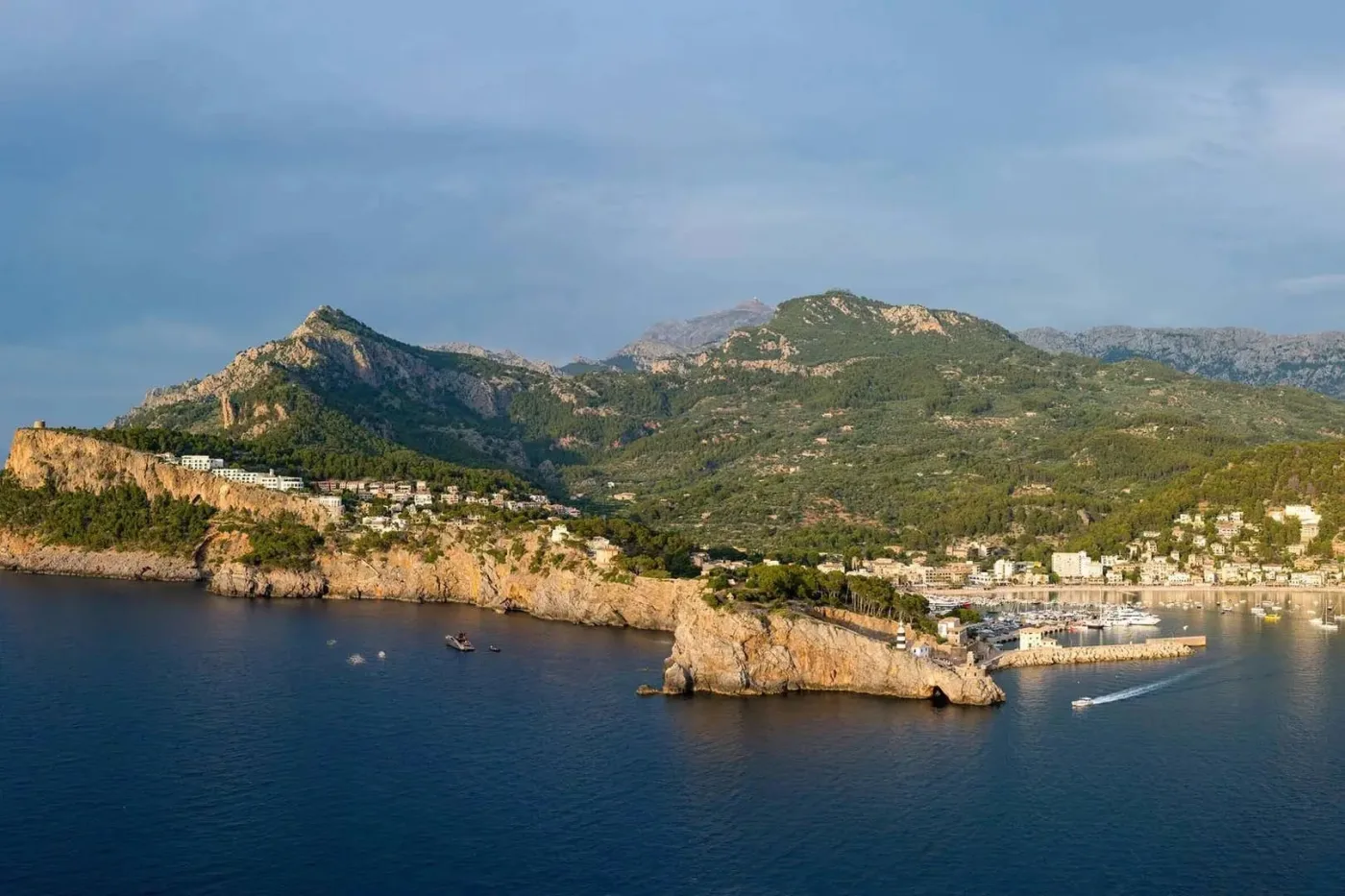
The Serra de Tramuntana — the mountainous northwest, a UNESCO World Heritage landscape — is where the island is at its most beautiful and where its best hotels cluster. This is Deià, Sóller and Valldemossa: terraced olive groves, stone villages, and cliffs falling into deep blue water. The north, around Pollença and the Formentor peninsula, is pine-backed beaches and one grand old hotel reborn. Palma and its bay give you a real city — the cathedral, the old town, a working marina — with a fortress-hotel sitting across the water. And the quieter east and interior trade sea views for agroturismo calm.
If what you want is a nightclub-and-beach-club summer, that’s Ibiza’s department, not Mallorca’s. Mallorca’s energy is closer to the overdue-moment story now playing out on Sardinia: an island with real depth that the luxury market took its time noticing. You come here for the mountains, the swimming coves, and long lunches — though the island’s beach clubs hold their own when you want them.
Four Seasons Resort Mallorca at Formentor
The most consequential hotel opening on the island in a generation is really a reopening. The Hotel Formentor first welcomed guests in 1929 and spent decades as the grande dame of the north before fading. Four Seasons took it over, closed it, and reopened it in August 2024 as a 110-room resort — 31 of them suites — set on roughly 100 acres of seafront pine woodland with a working vineyard on the estate.

What you’re buying here is space and a beach that most of the island can’t match — the resort has its own crescent of sand on a protected cove, reached through gardens rather than a car park. Ask for a sea-view room with a terrace; a handful come with private plunge pools. It’s the pick for families and for anyone who wants a resort in the full sense, with the Tramuntana rising directly behind it.
Belmond La Residencia, Deià
If Formentor is the north’s grand resort, La Residencia is the soul of the Tramuntana. It opened in 1984 as the first hotel of its kind on Mallorca, built from two old manor houses — one of them dating to the 18th century — in the artists’ village of Deià, about 40 minutes’ drive up the coast from Palma airport. Sixty-seven rooms and suites are spread across the hillside amid olive terraces and a sculpture garden, with the village’s painters-and-poets history baked into the place.

This is the address for a certain kind of traveler: someone who’d rather have the mountains and the village than a beach at the door (the sea is a short drive or a donkey-assisted walk away). Request one of the hillside suites with a terrace facing the valley. Deià itself is walkable from the door — a rare thing at this level in Mallorca.
Son Bunyola: Richard Branson’s Tramuntana Estate
Twenty years in the making, Son Bunyola is Virgin Limited Edition’s Mallorca hotel, opened in 2023 inside a restored 16th-century finca on a 1,300-acre estate above the coast near Banyalbufar. It’s 26 rooms and suites in the main house, plus three standalone villas that predate the hotel — the kind of place you book for a family or a group that wants the whole hillside to itself.

The setting is the point: three miles of largely undeveloped coastline, terraced gardens, and the mountains behind, all inside a UNESCO-protected landscape. Sa Terrassa, the estate restaurant, is built around the property’s original olive press. For a group, the villas are the move; for a couple, a finca suite with a terrace over the valley. Either way it is the quietest of the marquee names on this list.
Jumeirah, Port de Sóller
Down the coast from Deià, above the horseshoe harbor of Port de Sóller, Jumeirah spreads roughly 120 rooms across a cluster of buildings on the clifftop. What sells it are the infinity pools and the terraces, all angled at the same view: the Tramuntana falling into the bay, the old fishing port below, the vintage tram rattling down to the water.

It’s the most view-forward hotel on the island and an easy one to recommend for a first trip, because Port de Sóller does the work for you: swim in the morning, take the antique train up to Sóller town, be back for a long lunch. Ask for a room in the buildings highest on the cliff, where the sea view is uninterrupted.
Cap Rocat: A Fortress on the Bay of Palma
The most unusual hotel in Mallorca is a 19th-century military fortress on the Bay of Palma, at Cala Blava, a short drive around the water from the city. Cap Rocat — a Small Luxury Hotels of the World member — keeps the drawbridge, ramparts and stone walls of the original garrison; the rooms are carved into the rock, connected by courtyards and battlements, with its own stretch of private coastline and a saltwater cove.

This is the choice for a couple who want drama and privacy over a big-resort scene, within reach of Palma’s restaurants and cathedral. The Sentinel suites — former gun emplacements cut into the cliff, each with a private plunge pool over the sea — are the rooms to request, and among the most distinctive on the island.
When is the best time to go?
June and September are the sweet spots. The island’s weather holds warm and sunny from late spring into autumn, but July and August bring peak heat and peak crowds. Come in June for long days and hills still green from spring, or in September, when the sea is at its warmest after a summer of sun and the crowds have thinned. May and October are quieter still and reward anyone who cares more about the mountains and the light than about swimming every day.
What You Actually Want to Know
Is Palma worth staying in? For a night or two, yes — the cathedral, the old town and the food scene deserve it. Palma’s best beds are townhouse hotels tucked into the old quarter, like Can Bordoy and Sant Francesc. Most travelers pair a couple of city nights with a longer stay in the Tramuntana.
Do I need a car? For the Tramuntana, effectively yes — the coast road is the whole point, and a car lets you move between Deià, Sóller and Valldemossa. If you’re staying put at Formentor or Cap Rocat, a driver for day trips works fine.
How many days do I need? Five to seven. That’s enough for two bases — say the mountains plus the north, or the mountains plus Palma — without spending the trip in the car.
Formentor or Deià for a first trip? Formentor if you want a beach resort with the family; Deià if you want the village, the mountains and the more romantic side of the island. Many people end up doing both.
Is Mallorca still a party island? Only where you point yourself. The south coast around Magaluf keeps that reputation; the Tramuntana, the north and Palma’s old town are a different island entirely.
Every hotel on this list, Noon’s advisors have worked with directly — which room actually has the view, which villa books before it’s ever listed, which week in September the water’s still warm. Tell us where you want to go, and we’ll build the trip around the answer.
By Amelia Ingram | July 23, 2026
Plan Your Next Journey
Work with a Noon Travel advisor for a trip that exceeds every expectation.
Get Started