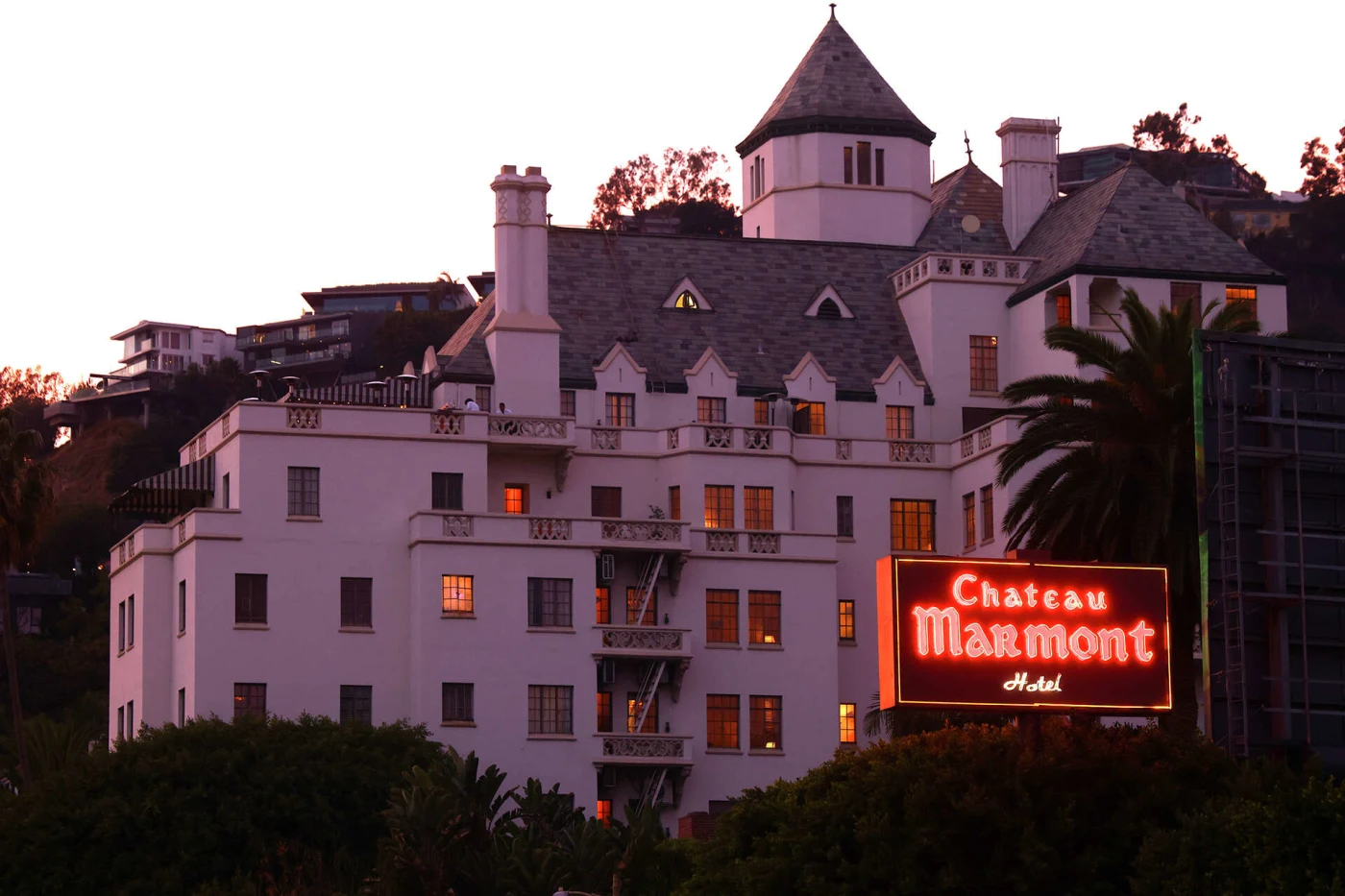

It sits above the Sunset Strip like a reproach — a Norman castle dropped into the Santa Ana winds, all turrets and white stucco and gothic dormers, watching the billboard money pile up below it. You can see the Chateau Marmont from the street, but that has never meant you were welcome inside. That distinction has always been the point.
Built in 1929 and opened during the first convulsion of Hollywood's sound era, the Chateau was conceived as luxury apartments — a place where people of means could live above the chaos of the city taking shape around them. It converted to a hotel in 1931. Within a decade it had become something else entirely: a geography of permission, a place where the rules that governed the rest of Los Angeles did not apply.
Harry Cohn, the famously autocratic head of Columbia Pictures, put it plainly to his roster of stars: "If you must get into trouble, do it at the Marmont." He was not offering advice. He was telling them where the walls were high enough.
The discretion was structural. Rooms were accessible through multiple entrances. Bungalows were screened by vegetation so dense you could hear a party before you could see it. Staff were hired for their indifference. The pool — shallow, cold, and surrounded by overgrown hedges — was more confessional than amenity. What happened there stayed there, because everyone at the Marmont had something to lose and everyone understood the arrangement.
Howard Hughes rented the penthouse for a stretch in the 1940s and used it as a surveillance post, training binoculars on the women sunbathing below. Desi Arnaz kept a suite as a marital escape valve — whenever he and Lucille Ball fought badly enough, he retreated to the Marmont, and on one occasion a briefcase full of cash was thrown from a terrace and burst open over Sunset Boulevard. Director Nicholas Ray moved into a bungalow in the early 1950s and essentially staged the rehearsals for Rebel Without a Cause from his room, where James Dean, Natalie Wood, and Sal Mineo would come to read scenes while Ray — who had been living at the hotel for eight years by then — presided over the whole arrangement with what can only be described as territorial authority.
Led Zeppelin stayed in 1969. John Bonham received a Harley-Davidson for his 25th birthday and, with the full encouragement of a bungalow full of people who should have known better, rode it through the lobby. Robert Plant reportedly leaned from a window and announced to no one in particular: "I am a golden god." Bonham returned the next morning, paid for the carpet damage, and left the bike. The tire marks stayed on the property for years, until new owners eventually covered them over. The rock cognoscenti considered this an act of minor vandalism.
Jim Morrison fell two stories from the roof of a Marmont bungalow sometime around 1970, attempting one of his notorious Tarzan maneuvers — swinging between windows and balconies along drainpipes, which he did often enough that it had acquired the quality of a ritual. He landed on his back. The injury gave him chronic pain for the remaining year of his life. Some accounts hold that it contributed, in ways that were never fully traced, to his death in Paris in July 1971.

The hotel survived all of this the way it survived everything — by remaining largely silent on the subject. The Chateau has never published a guest book. It has never issued a press release about its history. The mythology accrued around it the way rust accrues around iron: through exposure, through time, through the indifference of a building that does not care what you think of it.
Then came March 5, 1982.
John Belushi had been checking in and out of the Marmont since the mid-1970s. He was well-known to the staff, comfortable in his habits, and by February of 1982, residing in Bungalow 3 while working on scripts with his collaborators. He had been clean for a period before the trip. He was not clean now. On the night of March 4, a drug dealer named Cathy Smith administered a series of injections of heroin and cocaine — a speedball — while Robin Williams and Robert De Niro passed through the bungalow at various points of the evening. Belushi was found dead the following morning by his trainer and bodyguard, Bill Wallace. He was 33.
The tabloid machinery that descended on the hotel in the aftermath was unlike anything the Marmont had weathered before. For fifty years, its reputation for discretion had been a kind of ambient fact — understood, unquestioned, unremarkable. Belushi's death converted that discretion into infamy. Dark-humored future guests asked to be put in Bungalow 3. Rick James and Jean-Michel Basquiat both requested it specifically. The hotel, characteristically, declined to comment.
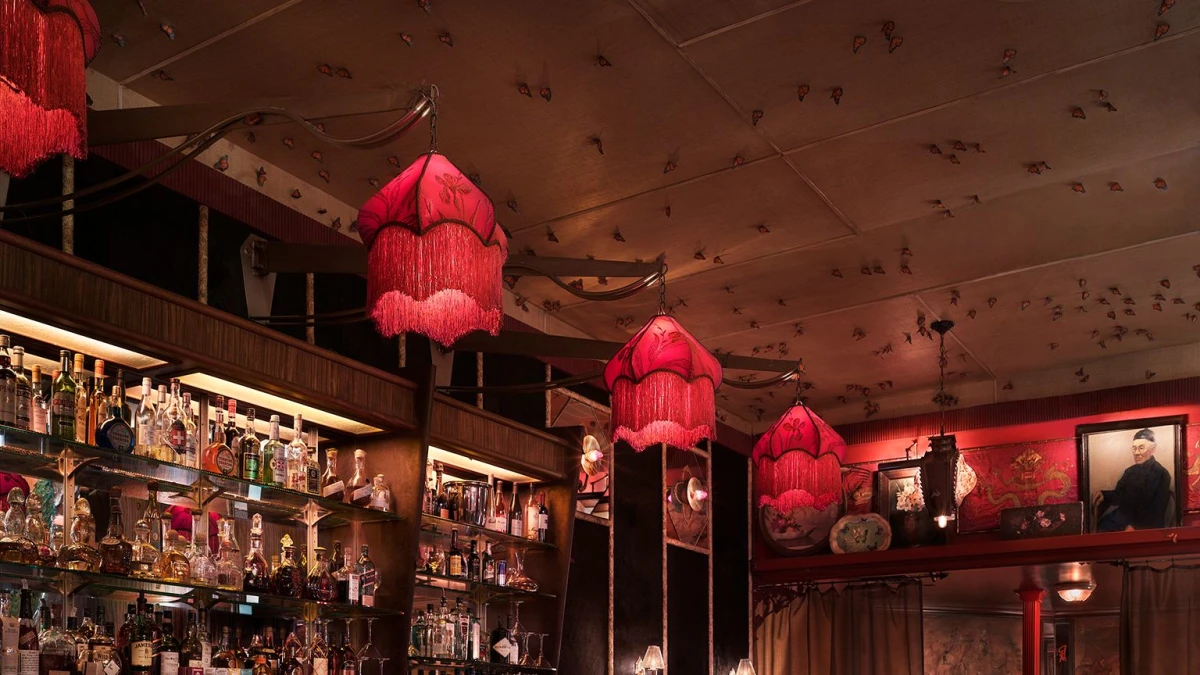
André Balazs purchased the Chateau Marmont in 1990 and oversaw its renovation into the version that exists today — the lobby kept deliberately dim, the furniture chosen for its studied lack of coordination, the restaurant positioned as a place where industry business could be conducted without anyone appearing to conduct it. Balazs understood the hotel's essential character: it was not glamorous in the conventional sense. It was glamorous in the way that things which refuse to explain themselves are glamorous. He left it largely alone.
The stories did not stop. Lindsay Lohan ran up a bill of more than $40,000 without the means to settle it. Scarlett Johansson and Benicio del Toro were reported to have gotten acquainted in the elevator. Beyoncé and Jay-Z held a top-secret Oscar-night afterparty in the garage. Helmut Newton — the legendary fashion photographer who had been staying at the Chateau for years, who regarded it as a second home — suffered a heart attack while driving out of the property on January 23, 2004. His car crossed Marmont Lane and struck the retaining wall on the opposite side of the street. He died at Cedars-Sinai. A memorial plaque now sits in the ivy of that wall, slightly hidden, as if the Marmont preferred its losses understated.

In recent years, Balazs has spoken publicly about converting the hotel into a private members' club — a structure in which guests would purchase ownership stakes and access residences across multiple properties. The exact timeline remains unclear. What is clear is that the Chateau Marmont, even as a conventional hotel, has always operated as though it were a private club. The rooms are expensive. The restaurant is not easily booked. The pool is visible from the street and inaccessible to everyone who cannot explain their presence there.
You can stay there tonight, if the room is available. The bungalows sit back behind the main building, screened by the same overgrown vegetation that has always provided their cover. Bungalow 3 has been renumbered. The carpet where the motorcycle tore through the lobby has been replaced. The plaque for Helmut Newton is in the ivy if you know where to look.
The Chateau Marmont at 8221 Sunset Boulevard does not advertise its history. It does not need to. The history arrives with you, the way it always has — carried in through a side entrance, up a back staircase, into a room where the curtains are drawn and the lighting is low and the understanding, unspoken, is that whatever happens here stays here. Or at least it used to. The hotel has made more news in the last decade than in its entire previous eighty years. The walls, it turns out, are not quite as high as Harry Cohn believed.
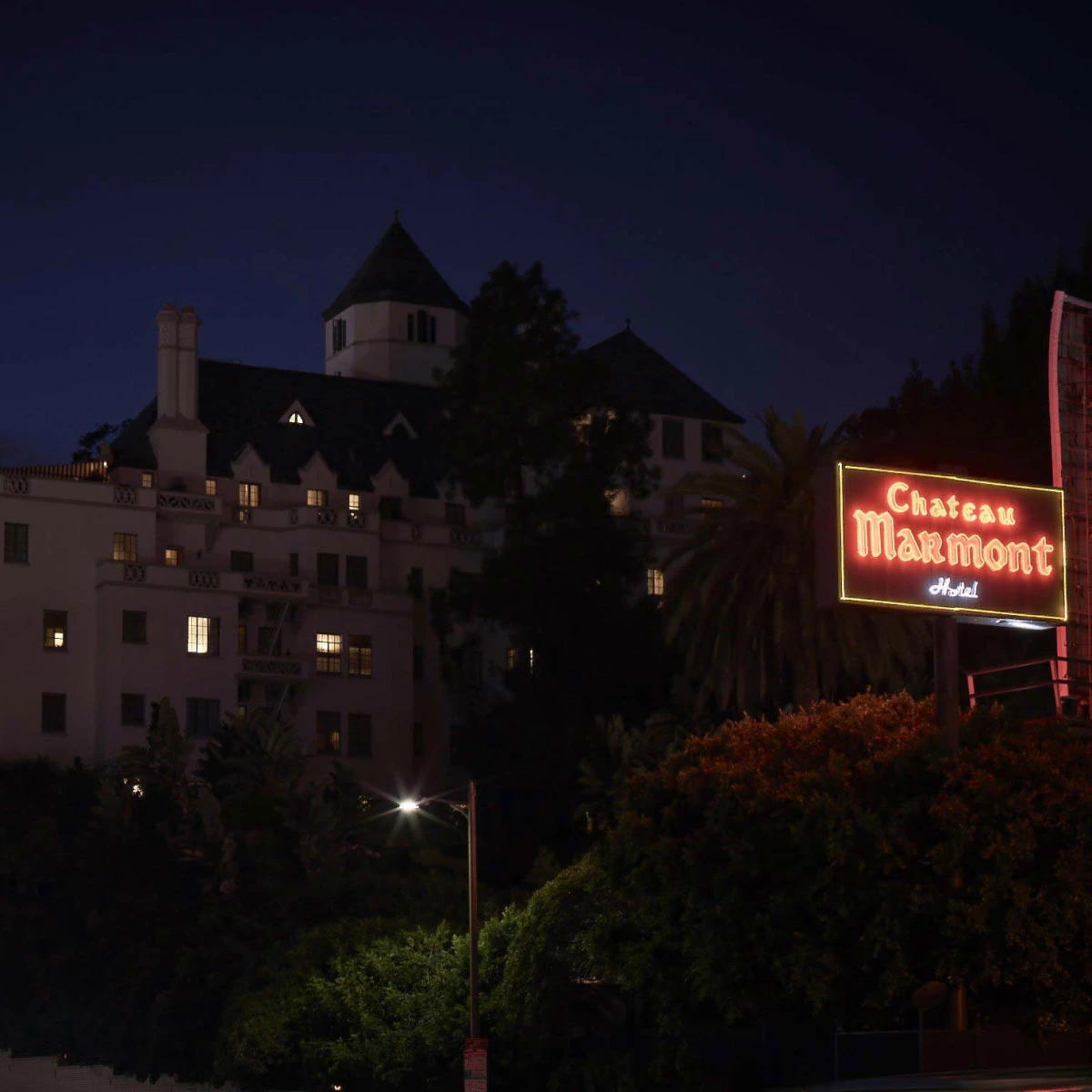
Some things, though, remain unchanged: the neon sign above the Strip, buzzing red against the Hollywood dark. The Norman towers. The pool. The sense, when you arrive, that you are entering a place that was here before you and will be here long after — and that it has seen worse, and kept quieter about it, than you will ever know.
Planning a trip to Los Angeles and looking for something beyond the standard hotel experience? Noon's advisors know these properties — and how to get you into the right room.
Plan Your Next Journey
Work with a Noon Travel advisor for a trip that exceeds every expectation.
Get Started