The short version
Grasse is a medieval hilltop town half an hour above Cannes where French perfume was born and still lives. You can tour three historic houses, blend your own scent at a perfumer's organ, and stand in the flower fields that supply Chanel and Dior. Come in late summer for the jasmine harvest.
Most people meet Grasse by accident. They are staying in Cannes or Antibes, the forecast turns, and someone suggests the perfume town in the hills. They spend two hours, buy a bottle, and leave. That is the wrong way to do it.
Grasse has been the working capital of French perfume for more than three centuries, and almost every scent you can name passes through it at some point — as a raw material, a formula, or a memory. The town sits about 35 minutes above the coast, high enough to catch a breeze the beaches never feel, close enough that you can be back on a terrace in Cap-Ferrat by dinner. Treated as a destination rather than a detour, it is one of the most quietly fascinating days on the whole French Riviera.
Here is how to read it like someone who understands what they are smelling.
Why was perfume born in Grasse?
Because of gloves. In the sixteenth century Grasse was a leather town, and tanned hides smelled exactly as bad as you would imagine. Local glovemakers began scenting their leather with the flowers growing all around them, and the perfume proved more valuable than the gloves. By the eighteenth century the town had reinvented itself entirely around fragrance.
The geography did the rest. Grasse sits in a sheltered bowl with a mild microclimate, spring water, and hillsides that grow jasmine, tuberose, and the centifolia rose better than almost anywhere in Europe. The flowers had to be processed within hours of picking, so the extraction houses grew up where the fields were. That accident of climate and timing is why a small Provençal town, and not Paris, became the source.
Which perfume houses should you visit?
Three historic houses anchor the town, and all three run free factory tours. Galimard, founded in 1747 by Jean de Galimard, a glovemaker-perfumer, is the oldest. Fragonard, created in 1926 by Eugène Fuchs, keeps a working factory and a museum in the center of town. Molinard, founded in 1849, is the third of the trio. You will smell the difference between a tour that is a genuine workshop and one that is mostly a boutique — do at least one of each.
The experience worth planning around is making your own. At Galimard's Studio des Fragrances, you sit at a perfumer's organ — the curved tiers of amber essence bottles a “nose” works from — and build a personal scent under guidance, then leave with the formula on file so you can reorder it. For the intellectual version, the Musée International de la Parfumerie, opened in 1989 and renovated in 2008, holds roughly 50,000 objects tracing perfume from antiquity forward. It is the only museum of its kind anywhere.

The fields that dress Chanel and Dior
This is the part visitors rarely see, and the reason Grasse still matters to the houses that could source flowers anywhere. Chanel has worked one family estate — the Mul family, near Pégomas — since 1987, a partnership set in motion by then-perfumer Jacques Polge. Chanel built its own extraction plant in the middle of the fields, and five harvests there are reserved exclusively for its perfumes: the May rose, jasmine, tuberose, iris, and geranium. The jasmine in Chanel N°5, the note Ernest Beaux chose when he composed it in 1921, still comes from these hills.
Dior made the same bet a generation later. In 2006 the house moved its perfume studio to Les Fontaines Parfumées in Grasse, and its perfumer-creator personally selected Domaine de Manon, run by Carole Biancalana — one of only a handful of jasmine grandiflorum growers left in Grasse — which now reserves its rose, jasmine, and tuberose harvests for Dior. When a bottle says “Grasse jasmine,” this is the field it means.
When should you go?
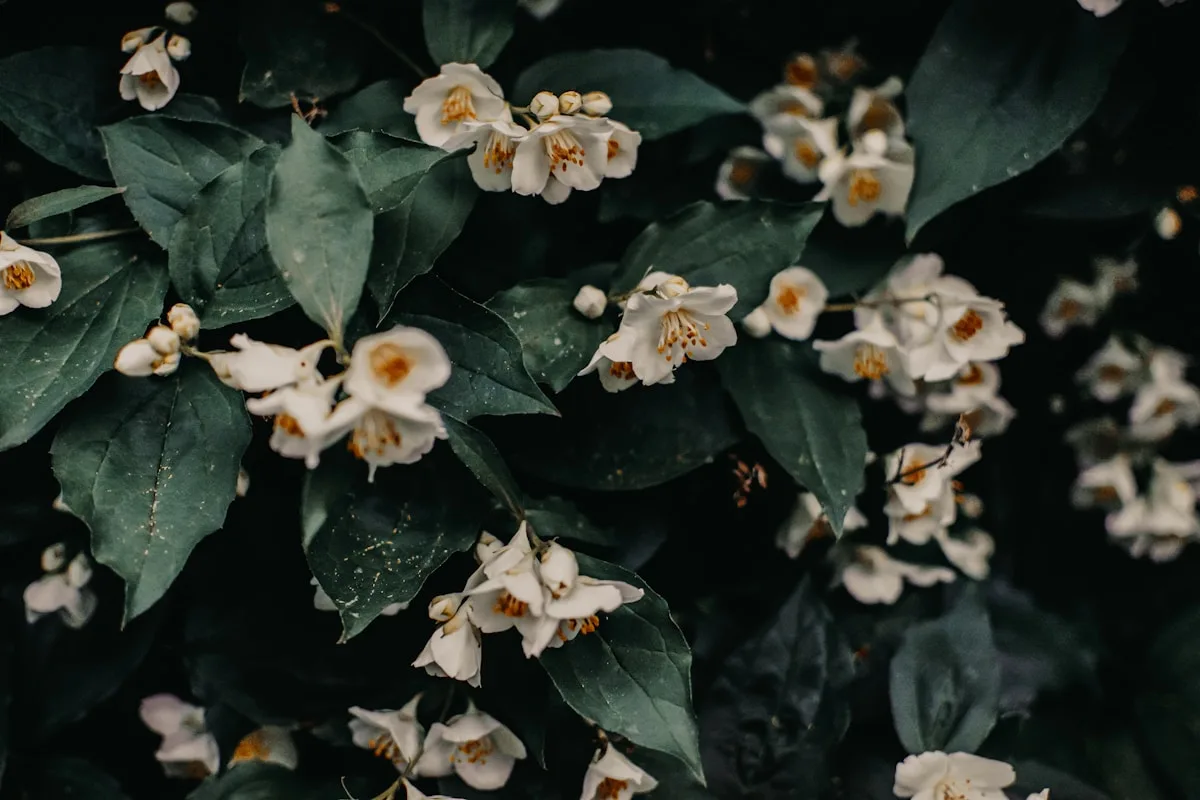
The flowers run on a calendar, and it decides your trip. The centifolia rose — the rose de mai — is a May flower, and only May; it is harvested over roughly three weeks and then gone for the year. Jasmine is the opposite: it is picked from late summer into October, flower by flower at dawn, and September is its fullest month. Tuberose fills the summer between them.
What that means in practice: a July or August visit puts you in Grasse just as the jasmine season opens, with the full heat of Provence and the fields still working. If your heart is set on the rose harvest, you are booking for next May. Either way, pair it with a few days in the hills — the lavender of inland Provence peaks across the same summer weeks, an easy drive north.

Where to stay near Grasse
Grasse itself has one address that matters: La Bastide Saint-Antoine, chef Jacques Chibois's seventeenth-century Provençal house set in an olive grove above the town, with sixteen rooms and a dining room that draws people up from the coast on its own. It is a Relais & Châteaux, and it is where to base yourself if the perfume is the point.
If you would rather sleep on the coast and drive up, two properties are within twenty to thirty minutes. Le Mas Candille, in the hill village of Mougins, is a Relais & Châteaux with 46 rooms and the only Shiseido spa in France, tucked into a bamboo garden. Château Saint-Martin & Spa, an Oetker Collection estate above Vence, has 41 rooms and six villas, an infinity pool over the Riviera, and a spa run with La Prairie. For a family or a group, a private villa in the hills puts the fields, the coast, and a kitchen of your own within the same half-hour radius.
What You Actually Want to Know
Is Grasse worth visiting?
Yes, if you treat it as more than a rainy-day errand. Give it a full day: one factory tour, a scent-making session, the perfume museum, and lunch. If you have any interest in how fragrance is actually made, few places on earth show it as directly.
How far is Grasse from Nice and Cannes?
Grasse is roughly 30 to 36 minutes by car from Nice Côte d'Azur Airport and about 40 minutes from Cannes. It makes an easy day trip from anywhere on the western Riviera.
Can you make your own perfume in Grasse?
Yes. Galimard's Studio des Fragrances and similar sessions at the other houses let you blend a personal scent with a perfumer and keep the formula on file to reorder. Book ahead in summer — slots fill.
What is the best time to visit Grasse?
Late summer, roughly August into September, catches the jasmine harvest, the signature Grasse flower. For the rose de mai, you need the three weeks of May. Both are lovely; they are simply different flowers.
Do Chanel and Dior really source flowers from Grasse?
They do. Chanel has grown its May rose and jasmine on a family estate near Pégomas since 1987, and Dior reserves harvests from a dedicated Grasse grower. The exclusivity is the reason the fields survive.
The difference between smelling a perfume and understanding it is usually a single afternoon spent where it is made. Noon's advisors know Grasse, its houses, and the estates most visitors never reach — and the properties worth the drive up. Tell us where you want to go.
Further reading
- Champagne: The Wine Region 46 Minutes From Paris
- A Private Island on the Côte d'Azur Just Got a Wellness Programme Worth Flying For
- 48 Hours in Monaco: An Insider's Guide
- COMO Le Beauvallon Is Open on the Gulf of Saint-Tropez
- Provence vs. Tuscany: Which Summer Should You Book?
- The Cappadocia Hot Air Balloon Experience — And Why It Lives Up to Every Photo
- How a Casino Saved Monaco From Bankruptcy
Plan Your Next Journey
Work with a Noon Travel advisor for a trip that exceeds every expectation.
Get Started