TL;DR: Croatia's Dalmatian Coast delivers some of the most striking luxury travel in Europe — UNESCO-listed medieval cities, superyacht harbors, Adriatic islands, and a handful of properties that genuinely belong in a different category. May, June, and September are the months to go. July and August are for someone else.
There is a moment, usually somewhere above Dubrovnik's city walls at golden hour, when you stop comparing Croatia to anywhere else. The limestone rooftops go amber. The Adriatic below shifts between every shade of blue it knows. And you understand, fairly quickly, that this is not a backup plan for Italy. This is the main event.
Croatia's luxury scene has matured substantially in the past decade. The Dalmatian Coast now supports a handful of properties that compete with the finest hotels in Europe — not just for setting, but for service, food, and design. The islands are better connected than they've ever been. And the crowds that once clogged Dubrovnik in midsummer have mostly taught the smart traveler one simple rule: come in May, June, or September.

Where to Stay in Dubrovnik
Dubrovnik is a small city, which means property location matters more than almost anywhere else. The two hotels that consistently outperform everything around them are Hotel Excelsior and Villa Dubrovnik — both on the water, both well outside the walled city's crowds, both worth the premium.
Hotel Excelsior Dubrovnik is the kind of place that earns loyalty. Built around the original 1913 Villa Odak and a sleek modern Tower addition, its 158 rooms and suites are divided between two very different architectural personalities — classical villa grandeur versus contemporary Adriatic cool. All of them face the sea. Three restaurants anchor the property: Prora, the beach-side dining room with a Mediterranean menu and Adriatic views; Sensus, the fine-dining option with an open kitchen and creative takes on Dalmatian ingredients; and Salin, the terrace where breakfast stretches long into the morning. The spa is a proper one — indoor pool, Turkish and Roman baths, Finnish sauna — and the platform beach gives you direct Adriatic access without fighting for a chair. The Old Town is a 10-minute walk. Former guests have included Queen Elizabeth II and Elizabeth Taylor, which tells you something about the atmosphere the hotel has always cultivated.
Villa Dubrovnik operates on a different frequency — 55 rooms, cliff-perched above the Sveti Jakov coast, with interiors just redesigned by Studio Arthur Casas in a 25 million euro renovation completed in 2025. It is quieter than Excelsior, more intimate, and the views of Lokrum Island and the Old Town walls from the upper floors are among the best in the city. A hotel shuttle makes the run to the Ploče gate in under five minutes.

Hvar: Croatia's Best Island for Luxury Travel
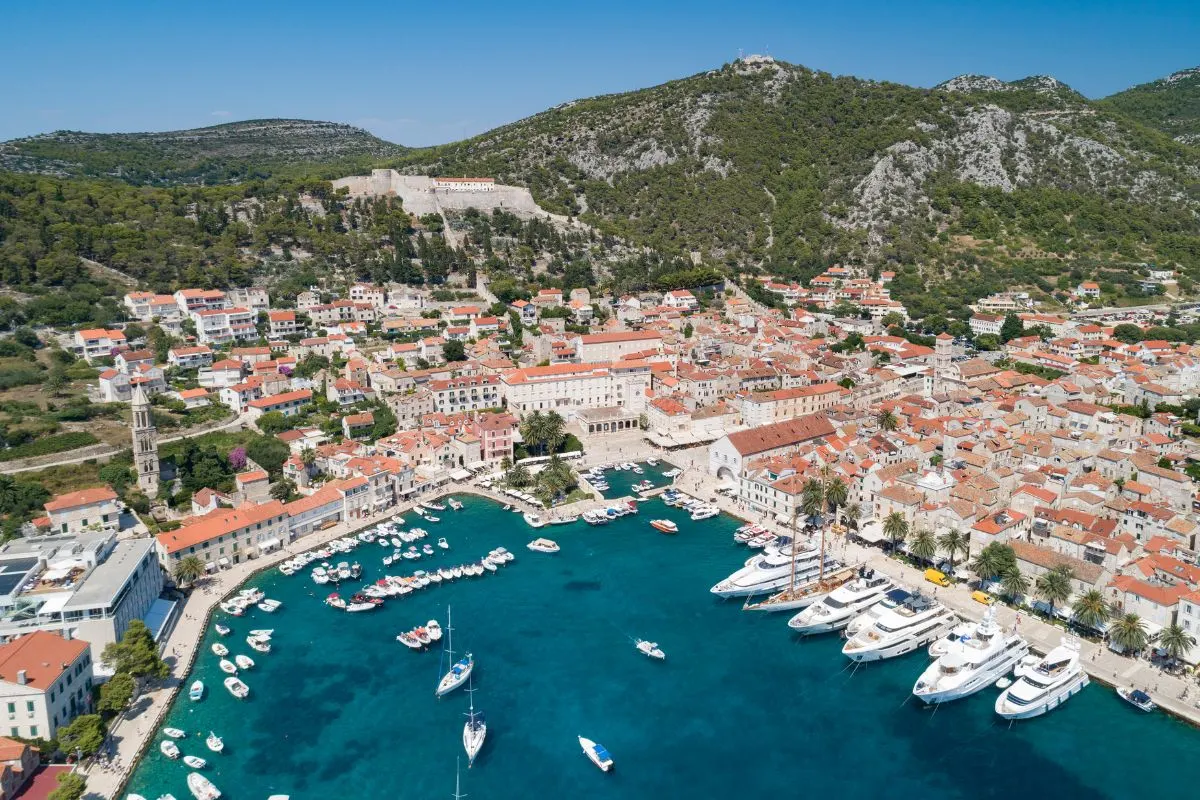
If Dubrovnik is Croatia's jewel, Hvar is its social capital — and the contrast is instructive. Hvar Town is glamorous in a European summer way: superyachts in the harbor, stone terraces above the Adriatic, a 16th-century loggia converted into the most atmospheric main square on the Dalmatian Coast. It earns the comparisons to the Balearics. But the island has more range than that reputation suggests.
The best property on Hvar — arguably the best hotel in Croatia — is Maslina Resort, a Relais & Châteaux member set into Maslinica Bay near the ancient town of Stari Grad. Fifty rooms and suites, plus three private villas. The resort is built into olive groves and pine forest across two hectares of coastline. Two pools. A spa that people travel specifically for. And a kitchen that takes Dalmatian ingredients seriously. It is not in Hvar Town, which is the point — Maslina trades the scene for something that feels genuinely restorative. Hotel shuttle runs to Hvar Town for those who want both.
For guests who want to be inside the energy of Hvar Town itself, Palace Elisabeth — a 19th-century palace on the main square, restored into a five-star hotel — is the address. The view of the harbor from the upper rooms is exactly what you came here for.

When to Go (And When to Stay Home)
May and June are the best months for Croatia. Temperatures run warm but not punishing, the lavender fields in the Hvar interior are in bloom, restaurant reservations are actually available, and the Old Town in Dubrovnik can be walked without negotiating tour groups four-deep. September is equally good — warm water, smaller crowds, and a pace that lets you appreciate what you came for.
July and August exist. They function. But Dubrovnik in August with 10,000 cruise ship passengers is a different destination than Dubrovnik in June. The hotels know this. The rates know this. If you have flexibility, use it.
Getting There and Getting Around
Dubrovnik Airport (DBV) handles direct flights from most major European hubs, and connections from the U.S. are straightforward via London, Frankfurt, or Amsterdam. Split Airport (SPU), about two and a half hours north, is an equally viable entry point — particularly if Hvar is your primary destination, since Split is the main ferry hub for the islands.
The catamaran between Split and Hvar Town runs roughly one hour each direction, with multiple daily sailings in season. For a more thoughtfully assembled arrival, private speedboat transfers from Split to Hvar or Dubrovnik can be arranged — it takes longer but the approach by sea is something you'll still be talking about at dinner.
If you're combining Dubrovnik with the broader Adriatic region, Croatia connects naturally with Montenegro's Bay of Kotor — the drive south from Dubrovnik to Tivat is just over an hour, and the transition between the two coastlines is one of the better scenic drives in Europe. We've written about Luštica Bay and Montenegro's luxury options in detail if you want to extend the trip.
What You Actually Want to Know
Is Dubrovnik worth it in 2026 given the crowds?
Yes — if you time it right. May, June, or September give you the city without the crush. The hotels outside the walls are excellent, and the Old Town at dawn or dusk is genuinely extraordinary. The problem is July and August, not Dubrovnik itself.
What is the best island in Croatia for a luxury trip?
Hvar, without much debate. It has the infrastructure, the accommodation quality, and the combination of nightlife and seclusion that makes it work across different travel styles. Maslina Resort near Stari Grad is the standout property; Palace Elisabeth puts you in the center of Hvar Town.
How long should you spend in Croatia?
A week is the minimum that does it justice — two to three nights in Dubrovnik, three to four nights on Hvar. Ten days lets you add a day trip to the Elaphiti Islands or an overnight in Split. Two weeks opens up Korčula and the Pelješac Peninsula wine country.
Is Croatia expensive for luxury travel?
It's comparable to southern Italy and significantly less expensive than the French Riviera. Five-star hotels in Dubrovnik run from roughly €400 to €800+ per night in peak season; Maslina Resort on Hvar starts around €500–700 in June. Dining and private charters are meaningfully more affordable than equivalent French or Italian options.
What's the best way to get from Dubrovnik to Hvar?
Drive or taxi to Split (approximately 2.5 hours), then take the high-speed catamaran to Hvar Town (roughly one hour). Alternatively, book a private speedboat transfer directly — it adds time but the coastal arrival is worth it. Croatian Airlines also operates the Dubrovnik–Split route in about 35 minutes.
Every itinerary Noon builds starts with one conversation — not a template. Start yours.
By Amelia Ingram | April 17, 2026
Plan Your Next Journey
Work with a Noon Travel advisor for a trip that exceeds every expectation.
Get Started