The school that once stood on this corner of Miyagawa-cho quietly shaped the neighborhood for generations. Children walked to it past the same wooden machiya townhouses that still line these streets. Then it closed, the building sat empty, and for a while the site held only a preserved sakura tree and whatever weight an empty institution carries. Capella Hotels walked in and decided the right move was to do nothing fast.
The result — Capella Kyoto, which opened on March 22, 2026 — is not a hotel that announces itself. The façade reads as a continuation of the Gion streetscape rather than a break from it. You could walk past it. That restraint is entirely intentional, and it sets the tone for everything inside.
Gion's Miyagawa-cho district is where you come when you want Kyoto at close range. Kenninji — the city's oldest Zen temple, founded in 1202 — is steps away. So is the Miyagawa-cho Kaburenjo Theatre, where geiko and maiko have performed since the Meiji era. Capella didn't pick a convenient plot; it picked the most culturally loaded few blocks in a city already saturated with cultural weight.
TL;DR: Capella Kyoto is the best new hotel in Japan in 2026. It opened in March in Gion's Miyagawa-cho district, with 89 rooms designed by Kengo Kuma, a restaurant partnership with three-Michelin-star SingleThread from California, and rates starting at $2,500 per night. It earns them.
What Does Kengo Kuma Actually Do With a School?
The commission went to Kengo Kuma and Associates — the Tokyo firm behind the Japan National Stadium built for the 2020 Olympics, among many others. Kuma's signature is the disappearing building: structures that defer to their materials and surroundings rather than competing with them. Here, working alongside interior designers Brewin Design Office out of Singapore, the approach was to build a hotel that feels like Kyoto rather than like a hotel about Kyoto.
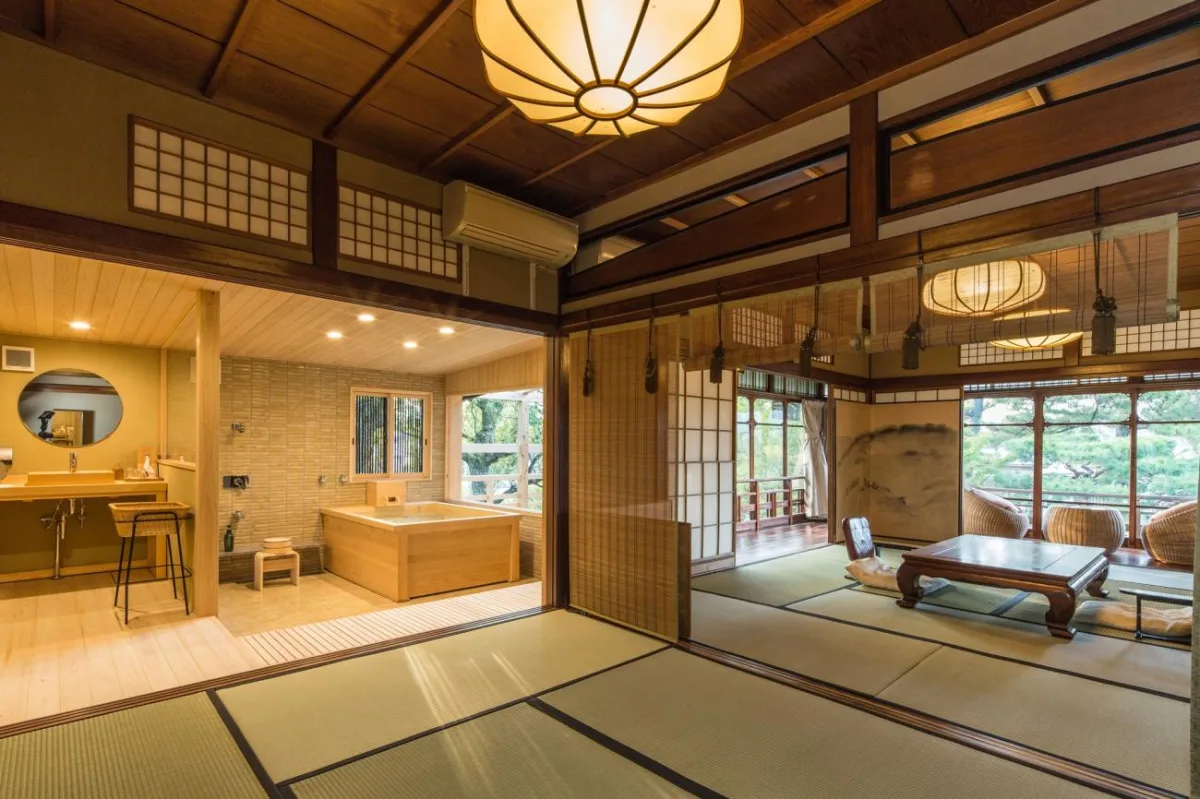
The organizing concept is the machiya, Kyoto's traditional wooden townhouse form — long, narrow, opening through layered thresholds from street to interior garden. Capella Kyoto uses this same logic spatially: you arrive gradually. Shoji screens, tokonoma alcoves, shimenawa rope motifs, and byōbu folding screens appear as architectural grammar rather than decoration. The materials are cypress, cedar, bamboo, and Nishiki-ori silk, all chosen for how they age.
The central courtyard contains a karahafu roof — the undulating gable form borrowed from imperial architecture — over an open-air performance space. The sakura tree from the original school site still stands here. Everything moves around it.
Is the Room Worth $2,500 a Night?
The 89 rooms — including six suites, each with a private onsen — all come with floor-to-ceiling windows and deep stone soaking tubs that nod to Japan's onsen tradition without being pastiche. The spatial logic holds at room scale too: light moves through shoji screens in patterns that shift with the time of day, and the materials against your hands and feet are the same ones on the walls and ceiling. Nothing is rushed.
The suite private onsens are the version of this hotel you would fly back for. Natural hot spring bathing is a specific kind of stillness, and having it inside a Kengo Kuma room in the middle of Gion is an experience that does not have a sensible comparative.
At $2,500 per night base rate, Capella Kyoto is priced above most of what Tokyo and Kyoto offer. What it has that few others do is a specific combination: the address, the architecture, the cultural access, and the table at SoNoMa. If you remove any one of those, the rate looks harder to justify. Together, they make it easy.

What's SoNoMa by SingleThread?
Kyle and Kate Connaughton opened SingleThread in Healdsburg, California in 2016. The restaurant holds three Michelin stars. The concept — a hyper-local, farm-driven kaiseki-influenced tasting experience — is a close philosophical relative of what Kyoto cooking has always done, which made the partnership with Capella logical rather than contrived.
At SoNoMa, the Connaughtons bring a Northern California perspective on local Kyoto produce. The menu reads as a conversation between the two food cultures rather than an imposition of one on the other. This is the right approach for a hotel that has staked its identity on paying attention to where it actually is.
Capella Kyoto's other two dining spaces hold their own. The Japanese restaurant was built using reclaimed wood from the original Shinmichi Elementary School, with lamps repurposed from the same building — the kind of material continuity that takes real commitment to pull off. The French brasserie opens directly onto a tsuboniwa moss garden, which means breakfast in April involves cherry blossom light and nothing else competing for your attention.
What Cultural Experiences Can Guests Access?
Capella Curates is the hotel's program of exclusive cultural experiences — three are available, none of which can be arranged independently without the hotel's introduction. The first is Whispers of Miyagawa-cho: a private ochaya (teahouse) session with maiko dance and live shamisen music. The ochaya relationship is one of the most guarded in Japan; walking in as a tourist is not possible. Walking in as a Capella guest is.
The second experience takes guests to a 150-year-old atelier for geta sandals — the wooden platform footwear that has shaped the sound of Kyoto streets since before the Meiji Restoration. The third is an urushi lacquerware session covering kintsugi repair, the art of making the broken places visible rather than hiding them.
These three experiences are not amenities in the hotel-brochure sense. They are the kind of access that takes a decade to develop and can only be offered by someone deeply embedded in the neighborhood. Miyagawa-cho has that density of craft and tradition. Capella had the patience to earn it.

Auriga Spa and the Case for Arriving Without an Agenda
The Auriga Spa includes three private onsen rooms, wet and dry saunas, and four treatment rooms alongside a contemporary fitness centre. Auriga is Capella's proprietary wellness brand, and in Kyoto it adopts a lunar wellness framework — treatments and recommendations shaped around moon phases, a concept that sits naturally in a city that still measures its festival calendar by the old almanac.
The honest recommendation for Capella Kyoto is to build more time than you think you need. Two nights is an itinerary. Three nights is a stay. Four nights is what the hotel was actually designed for — the pace at which the architecture, the food, and the neighborhood start to make sense as a single experience rather than a list of things done.
If you're planning spring travel to Japan, our guide to Japan in cherry blossom season covers timing, crowds, and the other considerations that determine whether April in Kyoto is the experience it should be.
What You Actually Want to Know
When did Capella Kyoto open?
Capella Kyoto opened on March 22, 2026, in the Miyagawa-cho district of Gion, Kyoto. It is the brand's first property in Japan.
What are rates at Capella Kyoto?
Rates start at $2,500 per night for standard rooms. Suites with private onsen are priced higher. The hotel recommends booking well in advance given demand for the opening year.
Who designed Capella Kyoto?
The architecture is by Kengo Kuma and Associates. Interior design is by Brewin Design Office, led by Robert Cheng, based in Singapore. The design concept draws from Kyoto's machiya townhouse tradition.
What is SoNoMa at Capella Kyoto?
SoNoMa by SingleThread is the hotel's signature restaurant, a partnership with Kyle and Kate Connaughton of SingleThread in Healdsburg, California — which holds three Michelin stars. The menu brings a Northern California perspective to local Kyoto produce.
Is Capella Kyoto worth it?
Yes, for the right traveler. The combination of Kengo Kuma's architecture, the Gion address, the SoNoMa dining program, and the Capella Curates cultural access program is genuinely rare. The rate reflects something that cannot be replicated at a lower price point.
The difference between a good Kyoto trip and a great one usually comes down to a single insider call. That's what we do.
By Amelia Ingram | April 18, 2026
Plan Your Next Journey
Work with a Noon Travel advisor for a trip that exceeds every expectation.
Get Started