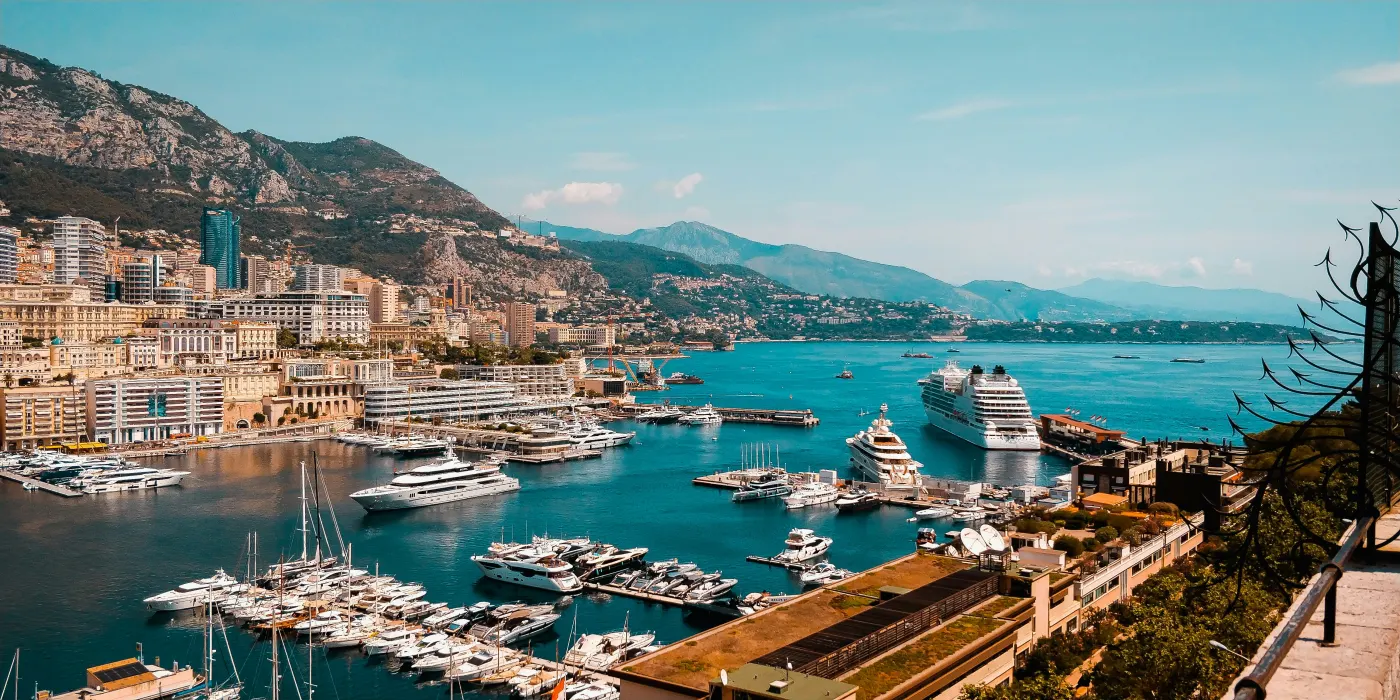


Monaco covers approximately two square kilometers. What visitors consistently underestimate is how much serious experience that square footage actually contains — the density of things worth doing, eating, and seeing is genuinely unusual for a place this size, and 48 hours, planned correctly, leaves nothing important on the table.
TL;DR: Monaco in 48 hours: Hotel de Paris for the address, the Rock and Oceanographic Museum in the morning, Le Louis XV for lunch, the Grand Prix circuit on foot in the afternoon, the Casino after 10pm. Get to Nice by helicopter in seven minutes.
Where Should You Stay in Monaco?
Two properties define the conversation, and choosing between them is really a question of what kind of Monaco you want.
Hotel de Paris Monte-Carlo has anchored Place du Casino since 1864. The address alone carries a century and a half of weight. Below the hotel, the wine cellars hold more than 300,000 bottles — the largest hotel wine cellars in the world. During Grand Prix week, balcony suites overlooking the circuit become some of the most sought-after vantage points in motorsport. Book those twelve months in advance.
Hotel Metropole Monte-Carlo sits two hundred meters from the Casino and offers a different register: the Joël Robuchon restaurant (opened 2004, designed by Jacques Garcia) draws serious food travelers in its own right, and Les Thermes Marins spa delivers thalassotherapy treatments that justify an extra night. If recovery is part of the itinerary, the Metropole is the more logical base.
Day One
Morning: The Rock
Monaco-Ville — the old town known as The Rock — sits 62 meters above the harbor. Start there. The Princely Palace changing of the guard happens at 11:55am sharp; arrive ten minutes early for a decent position. The ceremony is brief, precise, and worth seeing once.
From the Palace, walk east to the Oceanographic Museum. Founded by Prince Albert I and inaugurated in 1910, it remains one of the more serious marine science institutions in Europe. The aquarium runs deep — shark lagoons, touch pools, tanks that replicate specific ocean ecosystems. Allocate ninety minutes minimum.

Afternoon: Le Louis XV and the Circuit
Descend from the Rock and head to Hotel de Paris for lunch at Le Louis XV — Alain Ducasse's celebrated restaurant, and one of the defining tables of the French Riviera. The room alone commands attention: gilded ceilings, a scale that shouldn't feel intimate but somehow does. The menu leans into Provençal and Mediterranean ingredients with the kind of precision that makes the meal a full afternoon event.
After lunch, walk the Formula 1 Grand Prix circuit. The streets are public roads; nothing stops you from tracing the exact line the cars run in May. The famous hairpin at the Fairmont and the tunnel section — where drivers reach extraordinary speed before breaking hard into the chicane — are more visceral on foot than any broadcast communicates. The Automobile Club de Monaco has a museum nearby worth a quick stop.
For another iconic European sporting experience, a trip to Wimbledon operates on similar principles — exclusive access and advance planning are everything.
Evening: The Casino
Casino de Monte-Carlo opens its gaming rooms at 2pm, but the Casino after dark is a different proposition. Come at 10pm. The European Rooms enforce a jacket requirement for men; dress accordingly. The Belle Époque interiors — the atrium, the frescoed ceilings, the weight of the chandeliers — are the point as much as the tables. The adjacent Café de Paris runs later and looser, and handles the decompression well.
Day Two
Morning: Fontvieille and the Yacht Club
The Fontvieille district is Monaco's industrial quarter turned leisure zone — quieter, less trafficked, and home to the Collection of Classic Cars of H.S.H. Prince of Monaco. The collection spans more than a century of automotive history and belongs in the itinerary of anyone who walked the Grand Prix circuit the day before.
From Fontvieille, the waterfront walk to the Yacht Club de Monaco takes fifteen minutes. The building — designed by Lord Norman Foster and opened in June 2014 — is one of the more considered pieces of contemporary architecture in the principality. The terrace restaurant facing the harbor is a proper lunch spot: serious food, serious boats, no artifice.
Afternoon: Grande Corniche and Èze
Take the Grande Corniche — the high road connecting Monaco to Nice — in the afternoon when the light on the Ligurian coast is at its most direct. The drive delivers exactly what the mythology promises: limestone cliffs, Mediterranean blue below, the principality receding in the rearview.
Stop at Èze. The perched village above the lower Corniche is genuinely old — medieval foundations, stone lanes that tighten as you climb — and the views from the top reach back across the coast toward Monaco. The perfumeries that have made this stretch of the Riviera famous have a presence here; if the craft interests you, this is where to explore it.
When Is the Right Time to Visit Monaco?
The shoulder windows — early November through March and April before the Grand Prix — are the clearest answer. Temperatures are mild, hotels are at sensible rates, and the streets are navigable. The Monte-Carlo Masters (April) and the Grand Prix (May) are the two must-experience events, but both require booking six to twelve months in advance for the right hotel and table access.
Getting here: Nice Côte d'Azur is the regional hub, 22 kilometers away. The helicopter transfer from Nice to Monaco takes seven minutes and is entirely as cinematic as it sounds. Book it in both directions.
Grand Prix access: The Monaco Grand Prix runs each May. Grandstand tickets sell out a year in advance. The better hospitality positions — terrace suites at Hotel de Paris, private terraces along the circuit — operate on a similar timeline. Contact Noon advisors well ahead of the event year, not the event month.
Getting around Monaco: The principality is walkable end to end in under an hour. A car is a liability, not an asset. The public elevator system connecting the various levels of the city is free and well-maintained. Use it.
What You Actually Want to Know
How long do you need in Monaco?
Forty-eight hours covers the essential ground without feeling rushed. A third day adds room for longer spa time at the Metropole or a full day trip along the Corniche. Less than two days and you're just passing through.
What is the best hotel in Monaco?
Hotel de Paris is the definitive Monaco address — the history, the location, the wine cellars, the Formula 1 access. Hotel Metropole is the better choice if dining and spa are the priority. Both deliver at the top of the European luxury market.
Do you need a car in Monaco?
No. Monaco's elevator and stairway network links the different neighborhoods vertically; the whole city is walkable horizontally. Arriving by helicopter from Nice and moving on foot within Monaco is the cleaner approach.
When is the best time to visit Monaco?
Late September through early November and April before the Grand Prix offer the best combination of weather, manageable crowds, and hotel availability. July and August are peak season and fully priced. Grand Prix week in May is its own category — spectacular if you have proper access, frustrating if you don't.
The difference between a good trip and a great one usually comes down to a single insider call. That's what we do.
By Amelia Ingram
Further reading
- Monaco Grand Prix 2026: How to Do It Properly
- How a Casino Saved Monaco From Bankruptcy
- A Private Island on the Côte d'Azur Just Got a Wellness Programme Worth Flying For
- How to Book a Private Villa in the South of France
- COMO Le Beauvallon Is Open on the Gulf of Saint-Tropez
- The Perfume Lover's Guide to Grasse
Plan Your Next Journey
Work with a Noon Travel advisor for a trip that exceeds every expectation.
Get Started